
BG 2.47Sankhya YogaFeatured
You have a right to perform your duties, not to the fruits
The most quoted verse of the Bhagavad Gita on selfless action and detachment from results.
karmaactiondetachmentduty
Read the verse
Arutra Blog
Deep dives into Bhagavad Gita verses, mythology facts, and stories from Sanatan Dharma, all in one place.
The most quoted verse of the Bhagavad Gita on selfless action and detachment from results.

Krishna teaches Arjuna that pain and pleasure are temporary, and equanimity is the mark of a wise person.

One of the Gita's most profound declarations on the immortality of the Atman.

Krishna explains the cycle of birth and death using the analogy of changing clothes.

28 Jun 2026
It's 2am. You're not sleeping. Your brain is running twelve parallel conversations — all of them about things that haven't happened yet. The Bhagavad Gita was written for exactly this moment.
28 Jun 2026
You've probably used the word 'karma' this week. You probably didn't mean what the Bhagavad Gita means by it. Here's the version that will actually change how you live.
28 Jun 2026
At some point — maybe after a promotion that felt hollow, or a relationship that ended, or just a quiet Sunday afternoon — you've asked it. Why am I here? The Gita doesn't answer vaguely. It answers with uncomfortable precision.
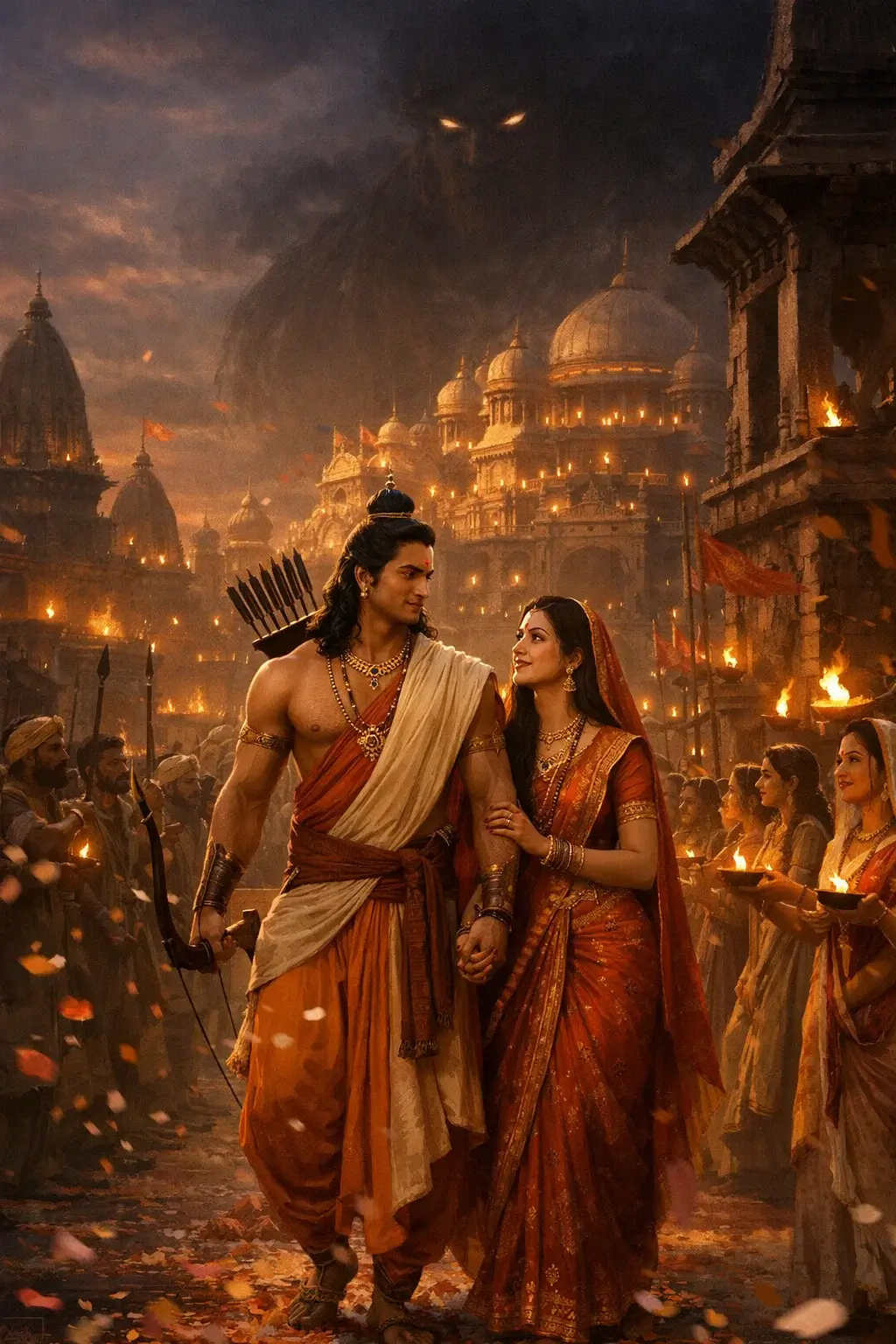
The epic journey of Ram, the prince of Ayodhya, from a perfect kingdom through exile, battle, and unwavering dharma. A story of duty, devotion, and the eternal battle between good and evil.

The divine leelas and wisdom of Lord Krishna, from Mathura to Kurukshetra. Explore the life of the one who turned every challenge into a lesson in dharma and devotion.

The extraordinary saga of Hanuman, the eternal devotee whose strength, courage, and surrender to Ram make him the greatest hero of Sanatan Dharma.

Why does Maa Kali stand on Lord Shiva?
There is a powerful scene described in the Devi Mahatmya. A fierce battle is raging. Demons are spreading terror, and the world feels like it is drowning in darkness. At that time the Divine Mother appears in her most intense form as Maa Kali. She is not gentle here, because the situation is not gentle. She is the force that removes evil when nothing else works. Kali defeats the demons, but after victory, her energy does not immediately settle. She becomes like a blazing fire that still wants to move, still wants to roar, still wants to run. In that unstoppable state, if her movement continues, it can shake the balance of the world itself. To calm her, Lord Shiva does something surprising. He does not fight her, and he does not command her. He simply lies down in her path. Kali, moving forward in her intense state, steps on Shiva. The moment her foot touches him, something changes. It is like a sudden awakening. She realizes what has happened, and the rage melts into awareness. In many depictions, she bites her tongue, not as childish shame, but as a symbol of returning to inner control. The deeper meaning is very simple and very profound. Kali represents Shakti, raw power and energy. Shiva represents pure consciousness, steady awareness. Energy without awareness becomes destructive. Awareness without energy becomes inactive. When Shakti is grounded in Shiva, power becomes protection, not chaos. That is why this image is shown in temples. It teaches a lesson for life too: when emotions rise like a storm, we need consciousness to hold us steady. Strength is holy, but it must walk with awareness.
What is the secret of the 'Akshaya Patra'?
In the Mahabharata, during the Pandavas’ exile, life in the forest was already difficult. Food was limited, danger was constant, and guests could arrive at any time. One day, a serious crisis appeared. Sage Durvasa arrived with a huge group of disciples. Everyone knew his nature: if he was not served properly, his anger could burn like fire. Draupadi was terrified. How could she feed so many people in the forest? But she remembered a divine gift she had received from Surya, the Sun God: the Akshaya Patra, an inexhaustible vessel. The blessing was beautiful, but it came with a rule. Each day, the pot would provide unlimited food until Draupadi herself ate. The moment she finished her meal, the pot would stop producing food until the next day. That day, the worst thing had happened. Draupadi had already eaten. The pot was empty. Durvasa and his disciples had gone to bathe and would return expecting a feast. Draupadi prayed with a trembling heart. Then Krishna arrived. He did not panic. He asked for food. Draupadi showed the empty vessel, ashamed and helpless. Krishna looked closely and found a tiny grain of rice stuck to the side. He ate it with full satisfaction. And then something miraculous happened. Durvasa and all his disciples suddenly felt completely full, as if they had already eaten a grand meal. Their hunger vanished, and they left quietly, without demanding anything. The secret of the Akshaya Patra is not only magic. It teaches a spiritual law: when the Divine is satisfied, the world becomes satisfied. It also teaches a practical lesson: abundance exists, but it works with discipline. The pot gave endlessly, but only within a rhythm. It reminds us that resources flow best when we live with gratitude, limits, and awareness.
Why do we do Pradakshina in temples?
When you visit a temple, you will often see devotees walking around the main shrine in a calm, clockwise circle. They keep the deity to their right side and move slowly, step by step. This is called Pradakshina. In the Skanda Purana, Pradakshina is described as a meaningful act of devotion, not just a habit. The temple’s inner sanctum is the spiritual center. By moving around the deity, the devotee is saying something without words: “You are my center. My life should revolve around you.” Clockwise movement also has symbolic value. It reflects moving in harmony with order, not against it. The circular path reminds us that life is a journey, and again and again we return to what is highest, what is pure, what is steady. Pradakshina is also a practice for the mind. When we walk slowly in a circle, the mind naturally becomes quieter. We stop rushing. We stop thinking about ten things at once. The body becomes rhythmic, and the heart becomes softer. Another simple meaning is humility. Instead of standing in front and demanding, we move around with respect. We accept that the Divine is greater than our ego. So Pradakshina is a small action with a big message: keep the Divine at the center, and let your steps become prayer.
During the Kurukshetra War, Arjuna's chariot was adorned with a flag bearing the image of Hanuman. This wasn't merely decorative; it was a symbol of divine protection. Hanuman, a staunch devotee of Rama and an embodiment of strength and devotion, resided on the flag to safeguard Arjuna and his chariot from harm. The presence of Hanuman on Arjuna's chariot was no accident. Lord Krishna, Arjuna's charioteer and divine guide, arranged it. Krishna knew the power of Hanuman's devotion and the potential dangers Arjuna would face in battle. It is said that all the divine weapons released by the Kauravas were absorbed by Hanuman on the flag, preventing them from harming Arjuna. After the war, when Krishna asked Arjuna to dismount the chariot first, and then He dismounted, the chariot immediately burst into flames. It was Hanuman's divine presence that had been protecting it from being destroyed by the sheer force of the divine weapons it had withstood throughout the battle.
Ashtavakra, whose name literally means 'eight bends', was born with physical deformities due to a curse. His father, Kahoda, was a renowned scholar, and while still in his mother's womb, Ashtavakra corrected his father's recitation of the Vedas. Enraged, Kahoda cursed his unborn child to be born with eight deformities. Despite his physical challenges, Ashtavakra possessed extraordinary intellect and spiritual wisdom. He famously challenged the court scholar Bandi to a philosophical debate at King Janaka's court. Bandi had defeated many scholars, and those who lost were drowned in the river. Ashtavakra, though young, defeated Bandi with his profound knowledge of the Vedas and Brahman. Bandi then revealed himself to be Varuna's son and released all the scholars he had drowned. Ashtavakra's victory not only freed the scholars but also restored his father to life, showcasing the power of true knowledge over physical appearance.
Daksha, one of the Prajapatis, performed a grand Yajna (sacrificial ritual) but intentionally excluded his daughter Sati and her husband, Lord Shiva. Daksha harbored resentment towards Shiva due to Shiva's unconventional appearance and lifestyle. When Sati learned about the Yajna, she felt compelled to attend, despite Shiva's advice against it. Upon arriving, Sati was deeply insulted by Daksha's derogatory remarks about Shiva. Unable to bear the disrespect shown towards her husband, Sati immolated herself in the sacrificial fire. When Shiva learned of Sati's death, he was overcome with grief and rage. He plucked a lock of hair and hurled it to the ground, from which emerged two powerful beings: Virabhadra and Bhadrakali. Virabhadra, under Shiva's command, stormed Daksha's Yajna, destroying the ceremony and beheading Daksha. Later, upon the request of the other gods, Shiva restored Daksha's life by attaching a goat's head to his body. This story highlights the consequences of ego, disrespect, and the immense power of devotion and divine wrath.
7 Apr 2026
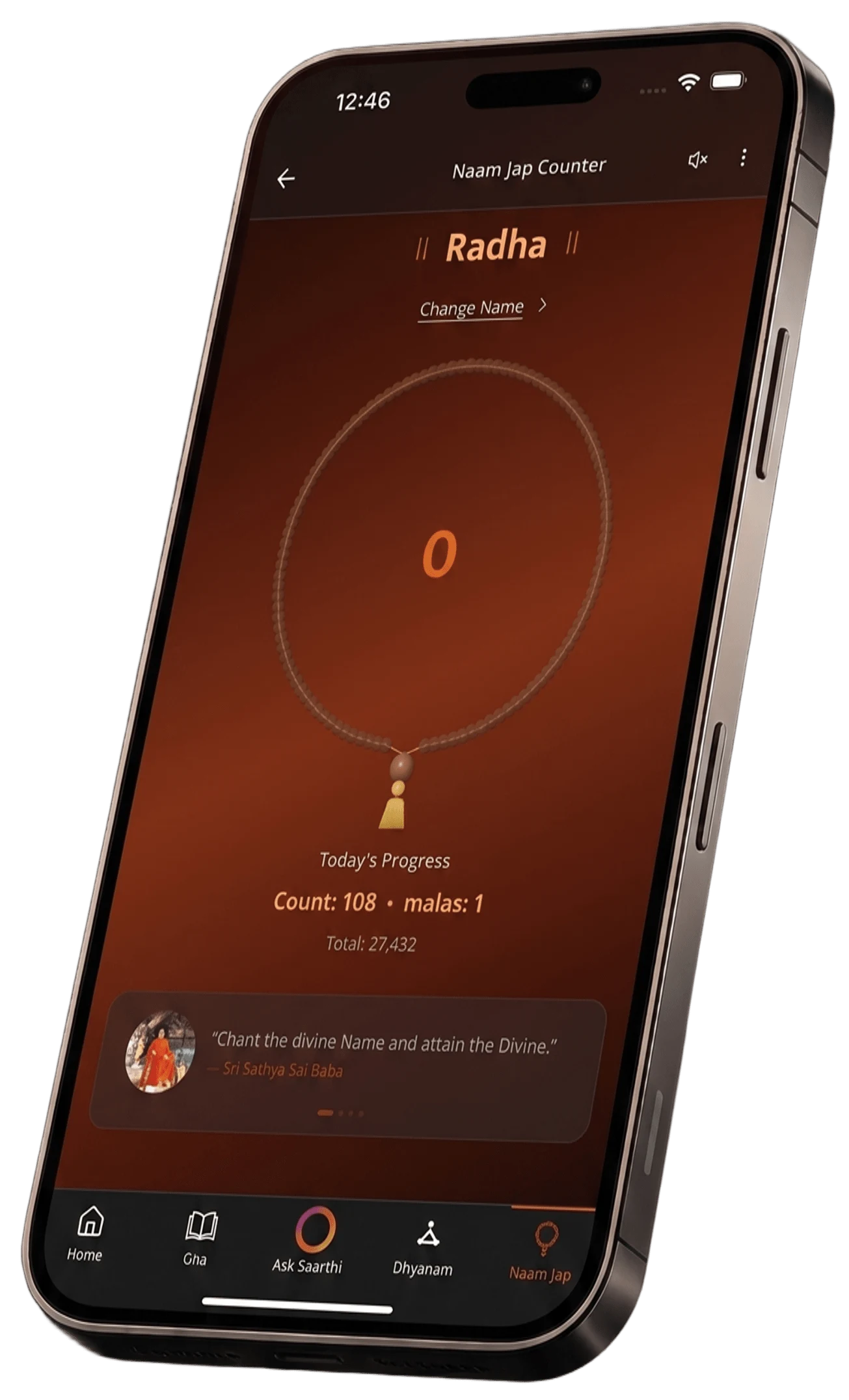
Naam Jaap is the ancient practice of repeating a divine name or mantra, and its benefits reach from the nervous system all the way to the soul. Here is why millions of people across India have kept this practice alive for thousands of years.
14 Apr 2026
The number 108 appears across Hindu scripture, astronomy, and anatomy. Understanding why japa malas have 108 beads reveals a worldview where mathematics and spirituality are not separate.
21 Apr 2026
Starting a Naam Jaap practice does not require a guru or a complicated ritual setup. What it does require is a clear intention, a chosen name or mantra, and the willingness to show up consistently.

8 Apr 2026
An AI spiritual guide is not a replacement for a human teacher, but it can serve as a patient, always-available companion for your questions about dharma, scripture, and practice. Here is how to think about what it offers.
15 Apr 2026
The spiritual path is full of genuine questions that do not always have simple answers. Saarthi AI is built to sit with those questions honestly, bringing scriptural depth without dogma and clarity without oversimplification.
22 Apr 2026
The Bhagavad Gita contains 700 verses that address nearly every dimension of the human condition. Saarthi AI makes its wisdom searchable, contextual, and personally applicable for the modern reader.

9 Apr 2026
Praarthana, which means longing or sincere asking, is the foundation of Hindu devotional life. It is not about reciting perfect words but about orienting the heart toward the divine with honesty and intention.
16 Apr 2026
How you begin the morning shapes the texture of everything that follows. The Hindu tradition offers a rich array of morning prayers and practices designed to align the day with something higher than the usual anxious rush.
23 Apr 2026
Lord Ganesha is invoked at the beginning of every significant undertaking in the Hindu tradition. The Ganesh Vandana is not superstition but a profound orientation, an act of acknowledging that intelligence and humility must precede every worthwhile effort.
10 Apr 2026
A bhajan is more than a devotional song. It is a vehicle for direct experience of the divine, shaped by centuries of poet-saints who found in music the most direct route to the heart of God.
17 Apr 2026
Meera Bai's bhajans are not gentle devotional songs. They are cries from the depths of total surrender, written by a woman who gave up everything for love of Krishna and found, in that giving up, everything she had ever sought.
24 Apr 2026
The Hanuman Chalisa is a 40-verse devotional poem composed by Tulsidas in the 16th century. It is one of the most widely recited prayers in India, and understanding its meaning transforms recitation from habit into genuine devotion.
10 May 2026
Meditation, or dhyana, is one of the most misunderstood words in modern spirituality. In the yogic tradition, it is not relaxation or focus or mindfulness. It is the state in which the boundary between the observer and what is observed dissolves.
12 May 2026
Starting a meditation practice is simpler than most people expect, and harder than most people hope. The difficulty is not in the technique. It is in showing up consistently enough for the practice to deepen on its own.
14 May 2026
The benefits of regular meditation are documented both in contemporary neuroscience and in the classical texts of the Vedantic tradition. These two bodies of knowledge are not in conflict. They describe the same transformation from different vantage points.