Search "Bhagavad Gita" on the App Store or Play Store and you will find dozens of results. Most of them do essentially the same thing: they show you the Sanskrit verse, a translation in English or Hindi, sometimes a commentary from a specific tradition, and not much else.
That is useful, but it is also just a digital version of a book you could already buy for fifty rupees.
The question worth asking is: what would a Bhagavad Gita app look like if it was designed to actually change how you live, not just give you access to text you could find anywhere?
What Most Gita Apps Get Right
Most apps in this category get the content right. The Gita's 700 verses are widely available, accurately translated, and often accompanied by quality commentaries — from Adi Shankaracharya's Advaita perspective, Ramanuja's Vishishtadvaita interpretation, or more accessible modern commentaries by teachers like Swami Vivekananda or Swami Chinmayananda.
If all you need is a clean, accurate, searchable version of the Gita text in English or Hindi, several apps will serve you well. The text is not the differentiator.
Where Most Gita Apps Fall Short
1. The Gap Between Reading and Applying
The Bhagavad Gita is not primarily a text to be read. It is a dialogue designed to be engaged with. Arjuna does not just sit and listen — he asks questions, pushes back, expresses doubt, and asks for clarification multiple times before he is ready to act.
Most apps replicate the lecture, not the dialogue. They give you Krishna's words but no way to bring your own question to them.
If you are reading Chapter 3 on the yoga of action (Karma Yoga) and you find yourself wondering how it applies to a specific situation in your own work or relationships, a standard app gives you no way to pursue that question. You either figure it out yourself or put the app down.
2. No Mechanism for Consistent Practice
Most people who download a Gita app read two or three verses enthusiastically, then never open it again. This is not a failure of willpower — it is a design problem. The app has no structure for building a sustainable daily relationship with the text.
A useful Gita app should have some way to make daily engagement easy, trackable, and meaningful. Not a notification you ignore, but a genuine practice structure.
3. Translation Quality Varies Enormously
Not all translations are equally useful. Some are extremely literal and almost unreadable in modern English. Some are loose to the point of changing meaning. Some carry the strong theological assumptions of their translator in ways that are not always flagged.
A good app either offers multiple translations — so you can compare — or is transparent about which translation it is using and why.
4. Hindi Support is Often an Afterthought
For many Indian users, especially those who learned the Gita from family or a pandit in a Hindi-medium environment, the English commentary is secondary. They want the Hindi. Many apps offer this, but often the Hindi translation is lower quality than the English, or the UI is not built to handle it well.
What a Genuinely Useful Bhagavad Gita App Looks Like
Here is a framework for evaluating any Gita app:
Does it help you apply the teaching, not just read it?
The Gita's central claim is that its teachings are directly applicable to the situations of ordinary life. An app that helps you bring your real questions to the text is more useful than one that just displays the text.
Does it build a practice, not just provide access?
Consistent engagement with the Gita over months creates a different kind of understanding than reading it once. An app that helps you build a daily habit — even five minutes — is doing something a static text cannot.
Is the translation quality high and clearly sourced?
Good apps are transparent about their translation choices and, ideally, offer comparison across multiple traditions.
Does it work in both English and Hindi?
For a text this central to Indian life, both languages should be first-class citizens.
Does it respect the tradition without being sectarian?
The Gita has been interpreted through Advaita, Vishishtadvaita, and Dvaita frameworks, among others. A good app presents the text without pushing one tradition's reading as the only correct one.
How Arutra Approaches the Bhagavad Gita
Arutra was built around a specific frustration: the best version of the Bhagavad Gita for a modern reader is not on any shelf or in any existing app. It would combine accurate text in English and Hindi, plain-language explanations that don't require prior knowledge, and some mechanism for actually engaging with the teachings in the context of your own life.
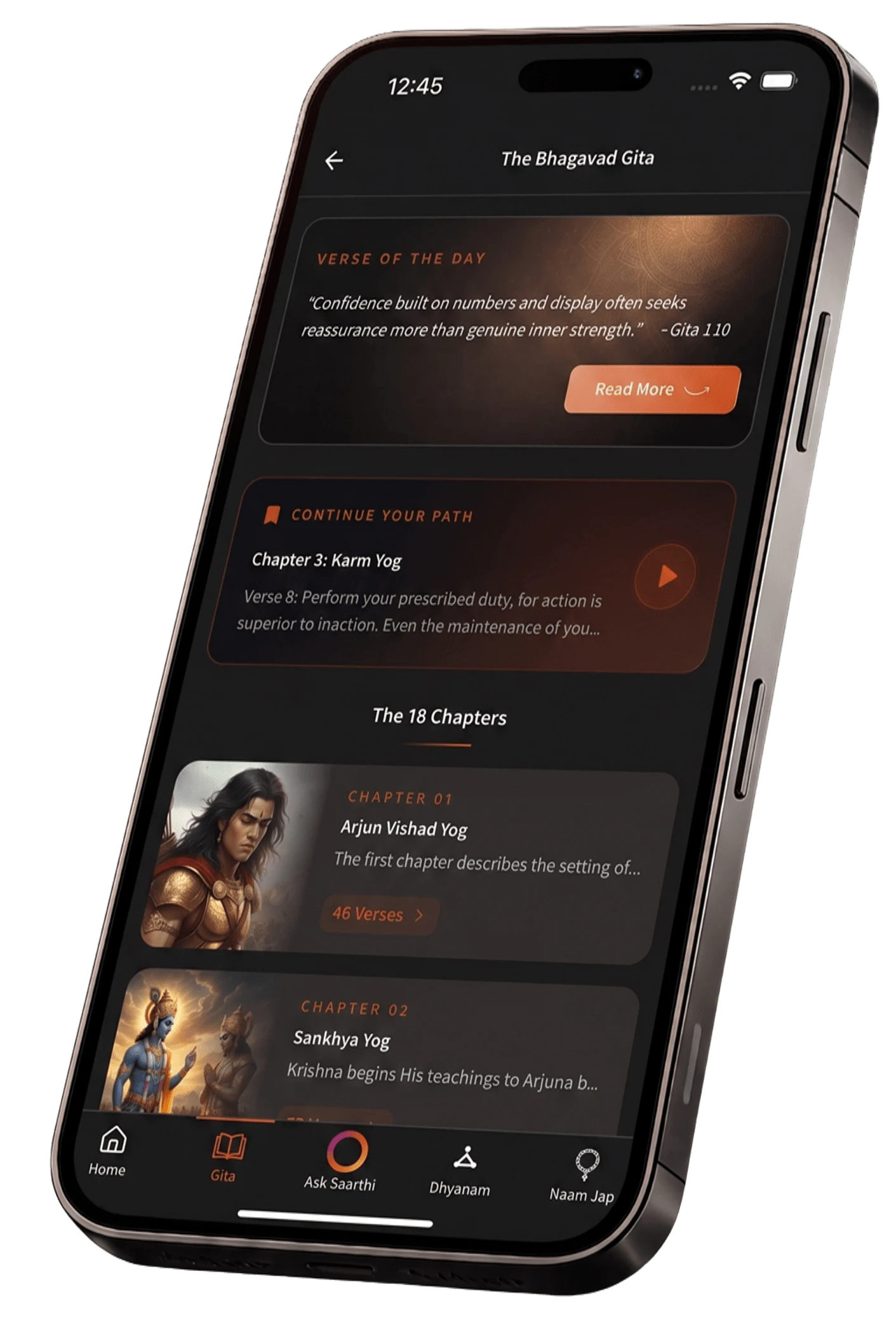
Gita Path covers all 700+ shlokas with Sanskrit text, transliteration, English and Hindi translations, and modern explanations written for readers with no Sanskrit or theological background. It is organized chapter-by-chapter and designed for daily reading in short sessions.
Saarthi AI addresses the application gap. It is an AI guide trained specifically on Bhagavad Gita teachings and 19,500+ real spiritual conversations. When you are reading Chapter 2 on impermanence and find yourself thinking about something specific in your life, Saarthi is there to engage with that question — not with generic advice, but through the Gita's own framework. The name Saarthi means charioteer, a reference to Krishna's role as Arjuna's guide.
Daily Sadhana handles the consistency problem. It tracks your Gita reading alongside Naam Jaap and Praarthana, maintains streaks, and shows you your progress visually. Small daily actions, made visible.
Arutra is free on Android and iOS. All of these features — Gita Path, Saarthi AI, Daily Sadhana — are available at no cost.
The Bottom Line
The best Bhagavad Gita app is not the one with the most verses or the cleanest interface. It is the one that closes the gap between reading ancient wisdom and actually using it in modern life. The Gita was always meant to be a dialogue, not a monologue. A good app honors that.
If you want to try Arutra, download it from the Play Store or App Store, or explore the Bhagavad Gita and Saarthi AI at arutra.com.
Experience it on Arutra
Download the Arutra App
Guided Bhagavad Gita sessions, Bhagavad Gita verses, Saarthi AI, and more. Free on Android and iOS.