
There's a specific kind of frustration that comes with spiritual practice: you know the practice works when you do it. You've had mornings where the Gita reading landed exactly right, or a japa session that left you genuinely settled for hours afterward. And yet the next morning comes and the practice doesn't happen.
This is not a willpower problem. It's a systems problem. And it's exactly what habit-tracking is designed to solve.
Why Spiritual Habits Are Harder Than Regular Habits
Tracking physical habits — exercise, water intake, sleep — is straightforward because the feedback is bodily and relatively immediate. You miss a workout and feel it the next day.
Spiritual habits are different. The benefits of a consistent Gita reading practice, or daily japa, or morning prayer accumulate slowly and non-linearly. A missed day feels like nothing. A missed week feels like not much. It's only after a missed month that something starts to feel off — and by then, the habit is already broken.
This is why accountability mechanisms matter more for spiritual practice than for most other habits. The feedback loop is too slow to be its own motivator.
What a Good Spiritual Habit Tracker Needs
Tracks the right practices
A generic habit tracker can technically track anything — you can add "Gita reading" as a custom habit and mark it done each day. But an app built specifically for spiritual practice will have these practices built in, with meaningful metadata: how many verses did you read today? How many malas? Which prayers did you complete? The granularity matters because it surfaces the actual practice, not just a checkbox.
Streak-based accountability
Streaks work because of loss aversion — once you've maintained a practice for 14 consecutive days, the cost of breaking the streak feels real. A good tracker makes your streak visible, reminds you before it breaks, and celebrates milestones (7 days, 30 days, 108 days) in a way that reinforces the identity of being someone who practices consistently.
Community or shared accountability
The Bhagavad Gita emphasizes satsang — gathering with those on the path — as one of the key supports for practice. An app that connects you with family members or a small group who share practice goals brings this principle into daily life. You're not just tracking for yourself; you're showing up for a shared commitment.
Linked to the practices themselves, not just the tracking
The best spiritual habit tracker isn't a standalone to-do list. It's connected to the actual practice — so when you log your Gita reading, you can open the Gita right there. When you log your japa, the counter is right there. The tracker and the practice live in the same place.
Simple enough to use every morning
A tracker that requires significant effort to update creates friction that compounds over time. The daily log should take under 30 seconds to complete so it becomes part of the practice, not separate from it.
What Arutra's Daily Sadhana Does
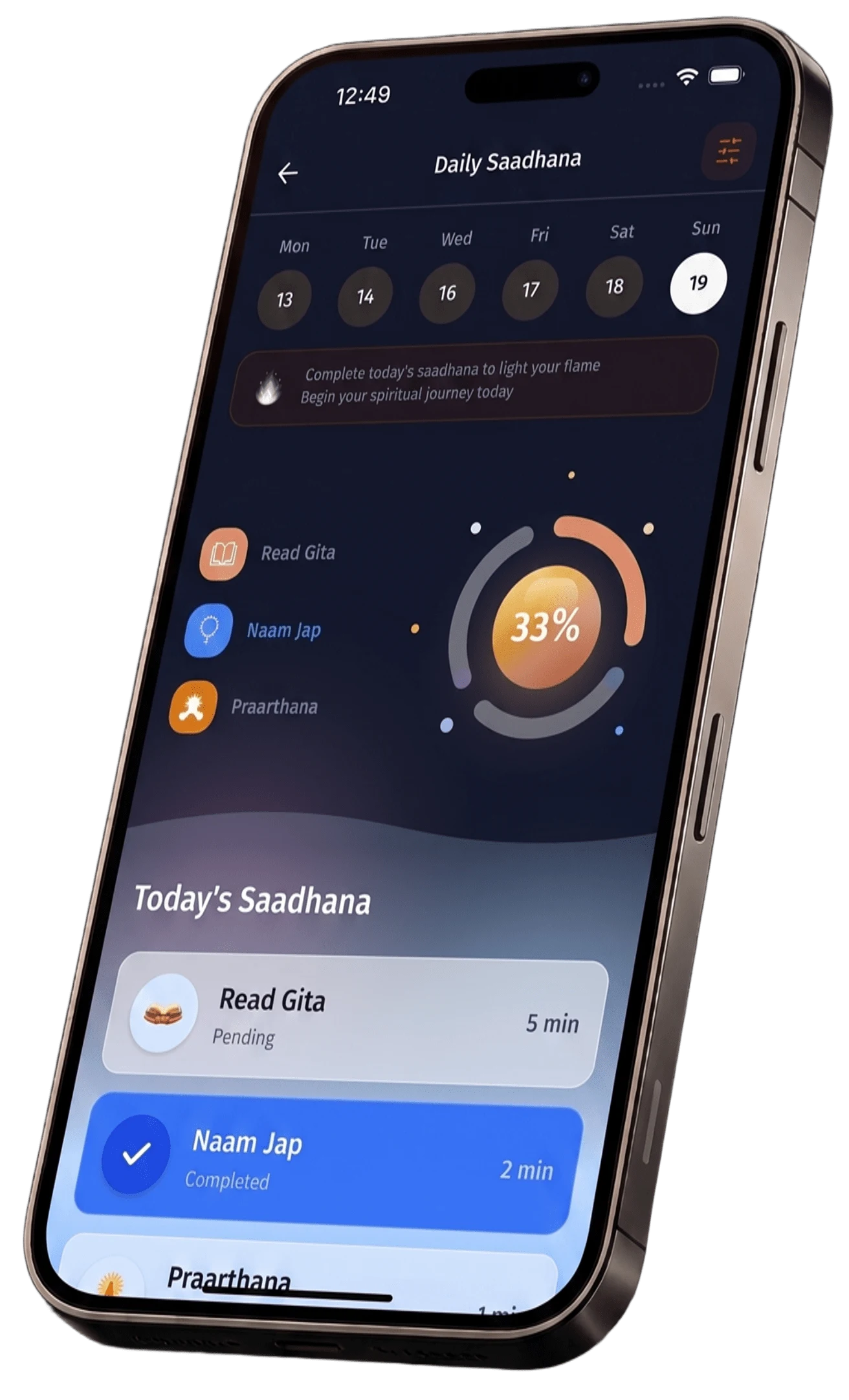
Daily Sadhana is Arutra's habit-tracking layer, built specifically for the practices the app supports.
Tracked practices: Gita reading (logged automatically when you read in Gita Path), Naam Jaap (logged automatically when you complete malas in Naam Jaap), Praarthana (logged when you complete your prayer), and meditation (manual log with duration). Every practice you already do in Arutra contributes to your daily log without extra effort.
Streak dashboard: Your current streak, your longest streak, and your total practice days are visible from the main dashboard. The app sends a gentle reminder before midnight if you haven't logged that day's practice.
Goal setting: You can set daily targets — e.g., 1 mala of japa, 5 verses of Gita, 10 minutes of prayer — and see whether you've hit them at a glance.
Parivar integration: Arutra's group practice feature, Parivar, lets you create or join a small group (family, friends, spiritual community) where everyone's Daily Sadhana progress is visible to each other. This is the satsang model implemented practically — accountability through shared practice.
Progress over time: Monthly and weekly views show your consistency across each practice category. You can see exactly which practices you're consistent in and which ones tend to fall away first.
The Deeper Point About Consistency
The Bhagavad Gita's Chapter 6 describes the qualities of a person established in yoga: they eat moderately, sleep moderately, exert moderately. The entire chapter emphasizes regulation — the steady, daily application of practice rather than occasional intensity.
"For one who eats too much or too little, sleeps too much or does not sleep enough — for them, yoga is not possible." (6:16-17)
A sadhana tracker is a technological implementation of this principle. It makes visible whether you are, in fact, showing up every day. And it makes the gap between intention and practice concrete — not as judgment, but as information you can act on.
Daily Sadhana is free on Arutra, available on Android and iOS. If you're already doing some spiritual practice but struggling to make it consistent, it's the most direct tool available for closing the gap between the practice you want and the one you're actually maintaining.
Experience it on Arutra
Download the Arutra App
Guided Meditation sessions, Bhagavad Gita verses, Saarthi AI, and more. Free on Android and iOS.