
Before any teaching on karma or dharma or duty, before any spiritual instruction, the Bhagavad Gita addresses death. Directly. Without softening it.
This tells you something important. The Gita seems to know that if the terror of death is still operating in the background, nothing else can be properly heard. So it deals with it first.
The Clothes Metaphor
"Just as a person puts on new garments, giving up old ones, similarly, the soul accepts new material bodies, giving up the old and useless ones." (Bhagavad Gita 2:22)
This is one of the most recognizable verses in the entire Gita, and for good reason. The metaphor does something no abstract argument can do — it makes the relationship between the soul and the body immediately, viscerally understandable.
You are not your clothes. They're yours. You care for them. You identify with them for a while. And then you let them go, and you're still there.
The Gita is saying that's what the soul does with the body. The body is an instrument — extraordinary, precious, worth caring for — but not what you fundamentally are. When the body is finished, what inhabits it moves on. Not to nothing. To a new form, shaped by the nature of the consciousness that left.
What Cannot Be Touched
"The soul can never be cut by weapons, never burned by fire, never moistened by water, never dried by wind." (Bhagavad Gita 2:23)
This verse has been recited at funerals across India for thousands of years. At the moment when a body is being given back to the elements, these words are spoken as a reminder: this is not what was lost.
The person is not the body. Whatever you are grieving — and grief is real, the Gita never dismisses it — what you're grieving is the particular form of a presence that continues in another form. The love doesn't end. The soul doesn't end. Only this configuration of matter, which was always temporary.
The Last Thought
"Whatever state of being one remembers when he quits his body, that state he will attain without fail." (Bhagavad Gita 8:6)
This is the verse that explains why daily practice matters so much. The quality of consciousness you carry into the last moment is shaped by the habits of a lifetime. The meditator whose mind naturally returns to the divine, the devotee whose love has been consistently directed toward something sacred, the person whose daily life has been built around truth and attention — each carries a different quality of awareness at the end.
This isn't meant to cause fear. It's meant to clarify what you're building every day.
Living Differently When You're Not Afraid
One of the most surprising things about genuinely engaging with the Gita's teaching on death is what it does to life.
When the fear of death is still running underneath everything, your choices become about avoiding the inevitable. You don't take risks that matter. You don't say the hard things that need to be said. You arrange your life around managing anxiety rather than actually living.
When you know — not just intellectually but in your bones — that what you actually are cannot be destroyed, something loosens. The kind of courage that the Gita calls for, the courage to do what is right even when it's costly, becomes more accessible. Not because dying doesn't matter. But because you know what dying isn't.
If Someone You Love Has Died
If you're reading this in grief, the Gita's second chapter was written for you. Not to rush your mourning. Not to tell you that you shouldn't feel what you feel. But to hold the loss in a framework that doesn't collapse under its weight.
The person you love still exists. In a different form, in a different place in the journey of consciousness. Your grief is the shape that love takes when the form it was attached to changes. That love, too, continues.
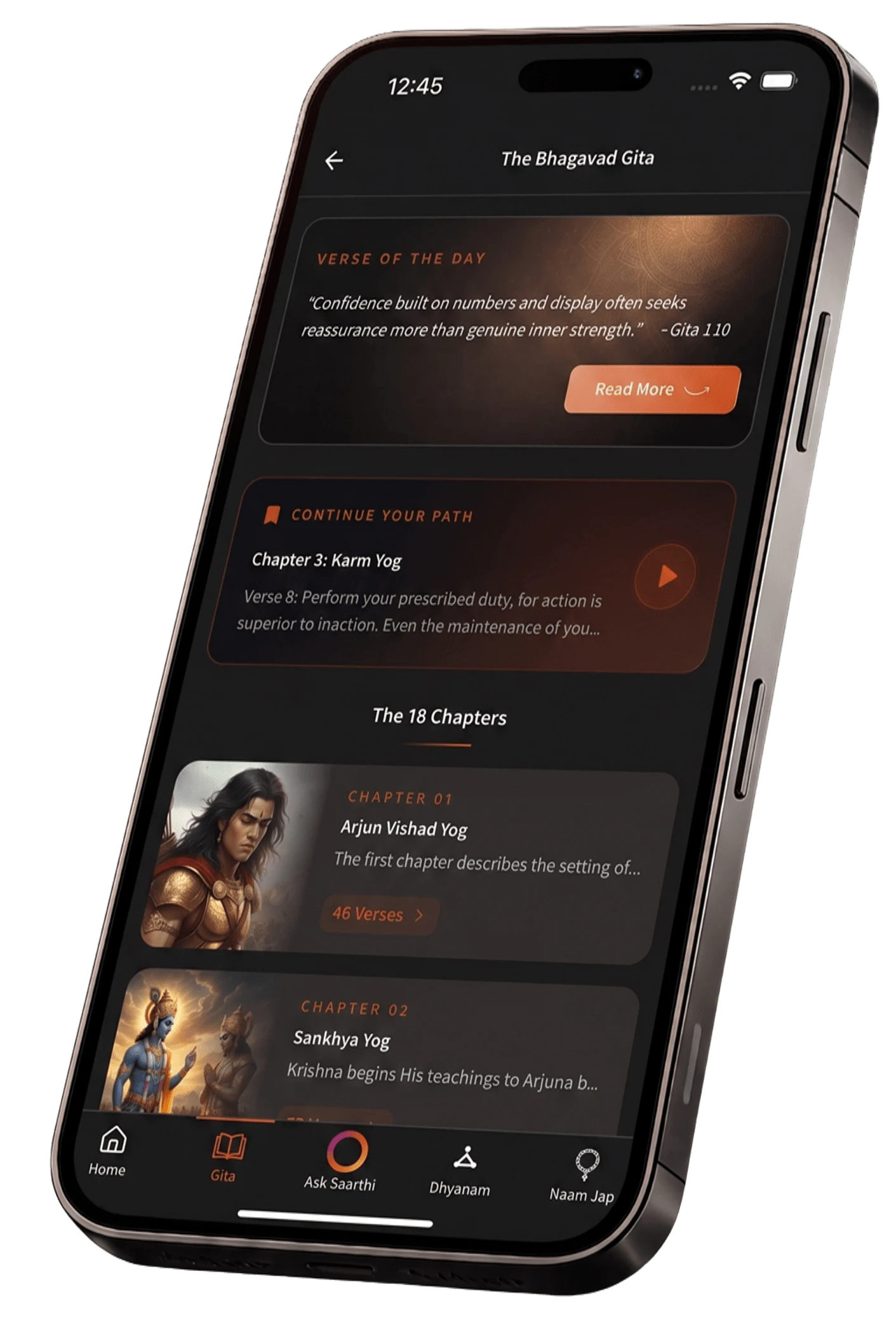
The Arutra app's Gita explorer has the full second chapter with verse-by-verse commentary. Saarthi AI can walk you through these verses personally, as slowly as you need.
Experience it on Arutra
Download the Arutra App
Guided Bhagavad Gita sessions, Bhagavad Gita verses, Saarthi AI, and more. Free on Android and iOS.