Arjuna is not afraid of the battle. He's facing something harder: complete loss of will. He knows what he's supposed to do. He has the skill. He has the training. And he absolutely cannot make himself do it.
He sits down on the floor of his chariot and says: I won't fight.
If you've ever lain in bed knowing you needed to get up, knowing there were things to do, feeling the day slipping past while you watched from inside the heavy fog of not caring — you know something about what Arjuna is experiencing.
What Krishna Actually Called It
Krishna doesn't call Arjuna's state cowardice. He doesn't even call it weakness in the ordinary sense. He calls it hridaya-daurbalyam — literally, weakness of heart. The kind of collapse that happens when a person loses their sense of purpose and their trust in their own capacity to act.
And then he says something that sounds almost harsh: "This impotence does not become you. Do not yield to it." (Bhagavad Gita 2:3)
He's not being unkind. He's refusing to let Arjuna's current state define him. The state is real. But it is not who Arjuna is.
Tamas: When the System Shuts Down
The Gita's three-guna framework is one of its most practically useful tools. Tamas is the quality of heaviness, inertia, resistance to movement. We all know it: the inability to get out of bed, the heaviness that sits on the chest, the sense that nothing matters, that no action could help, that the effort isn't worth it.
The Gita doesn't pathologize tamas. It recognizes it as a natural quality of nature that increases and decreases based on what you eat, how you sleep, the patterns you've built, and the quality of your recent actions.
This is the key insight: tamas is not permanent. It's a state. And states can be shifted. Not by waiting for them to change on their own — that's rajas pretending to be rest — but by introducing the specific kind of action that begins to dissolve them.
The Prescription That Feels Wrong
When you're in a tamasic state, the last thing you want to hear is "take action." It feels like being told to run when you can barely stand.
But the Gita is not asking you to run. It's asking you to move. One small thing. Not because the small thing will solve everything. Because movement itself, the Gita tells us, begins to change the quality of energy you're in.
This is not generic self-help advice. This is a precise understanding of how gunas work. Tamas increases with inaction. Every small act of engagement introduces a thread of sattva — clarity, lightness, upward movement — into the heaviness. You don't need motivation to act. The action produces the motivation.
The Trap on the Other Side
There's a version of "getting out of depression" that swings to the opposite extreme: frantic activity, hustle culture, exhausting yourself through constant doing. The Gita identifies this as rajas — agitation, restless striving. It's not health. It's tamas hiding under the appearance of productivity.
The Gita's goal is sattva: clarity, balance, steady engagement. A sattvic person does what needs doing with full attention and then genuinely rests. They don't oscillate between numbness and frantic motion.
The Soul Has Not Gone Dark
Here is the deepest thing the Gita offers to someone in depression: the heaviness you're experiencing is not your nature. It is covering your nature. The tamas that sits on you is not you — it is a condition, like weather. Beneath it is an awareness that has not been contaminated, has not lost its light, has not ceased to be what it is.
Every practice the Gita recommends — daily meditation, study of scripture, mantra, small acts of service — is a way of clearing the covering. Not forcing the light to shine. Just removing what's in the way.
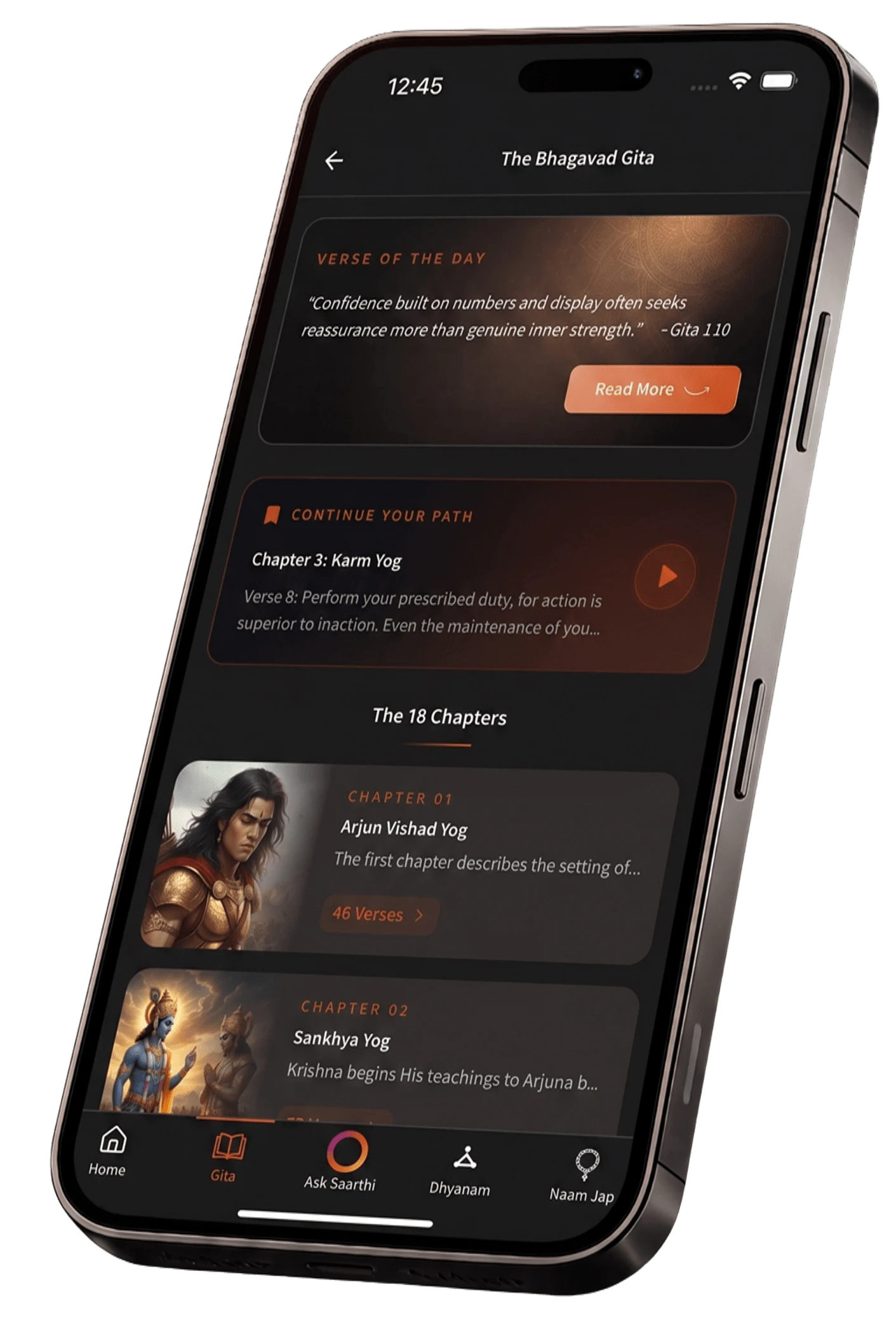
Start with one Gita verse in the morning. Just one. Before the phone, before the news, before anything else. Let Saarthi AI in the Arutra app be the wise presence you talk to when the heaviness is there and you don't know where to start.
Experience it on Arutra
Download the Arutra App
Guided Bhagavad Gita sessions, Bhagavad Gita verses, Saarthi AI, and more. Free on Android and iOS.