
There's a version of impostor syndrome that nobody talks about: the kind that shows up not when you're mediocre, but when you're actually capable. When you have the skills. When you've prepared. When there's no rational reason for the doubt.
Arjuna had no rational reason to doubt himself. He was the finest archer of his age. He had won battles that should have been unwinnable. He had Krishna himself as his guide. And right before the moment that all of it was preparation for, he fell apart.
This is how self-doubt usually works. It peaks not in the comfortable, low-stakes moments. It peaks when the cost of failure is highest and the requirement for full commitment is most demanding.
Krishna Refuses to Accept the Story
Here's what's remarkable about Krishna's response. He doesn't challenge the facts. He doesn't say "but look how capable you are, remember that battle you won?" He goes underneath the story entirely.
He says: "This impotence does not become you, O Arjuna. Do not yield to this unmanliness. Arise." (Bhagavad Gita 2:3)
He's not arguing with the fear. He's refusing to let the fear be the definition. There's a distinction between "I feel afraid" and "I am someone who is incapable." Arjuna has slipped from the first to the second. Krishna pulls him back.
What You Actually Are
The Gita's answer to self-doubt is not motivational. It's ontological. It's not "believe in yourself more." It's "know yourself more accurately."
And what Arjuna is told about himself:
"The soul is never born and never dies. Weapons cannot cut it. Fire cannot burn it. Water cannot wet it. Wind cannot dry it." (Bhagavad Gita 2:20, 2:23)
Strip away the metaphysical framing for a moment. What Krishna is saying is: what you actually are cannot be diminished by failure. Cannot be proven wrong by a bad outcome. Cannot be less than it is because a situation didn't go your way.
You are not your track record. You are not your last performance. You are not the story that fear tells about you when the stakes are high.
The Two Types of Fear
The Gita doesn't call for fearlessness. It calls for clear action despite fear.
There's fear as information: the flutter in the chest before a genuinely risky decision, the hesitation that makes you reconsider something that's actually dangerous. This fear is useful. It's worth listening to.
Then there's fear as habit: the reflexive contraction that happens regardless of actual risk, the internal voice that says you don't belong here or you're going to be found out even when there's no evidence for it. This is the fear that the Gita is addressing. It's not based on accurate information about you. It's based on a confusion between who you are and the temporary, circumstantial story your ego is running.
The Practice of Acting Anyway
The person the Gita describes as having overcome fear is not someone who never feels it. It's someone who has found a center that stands behind the fear. You don't become fearless. You become someone who can act from your deepest nature while the fear is there, without waiting for it to go away first.
This is what Arjuna does after the Gita is given. He doesn't report that he's no longer afraid. He reports that his doubt has been resolved, that he's clear about what he needs to do, and that he'll do it. The fear may still be there. The clarity is larger.
Building That Ground
You don't find that center by thinking about it. You find it by practicing it. Daily meditation that trains the witness perspective. Mantra that provides an anchor when the mind starts spinning stories. Scripture study that regularly reminds you of what you actually are beneath the roles and outcomes.
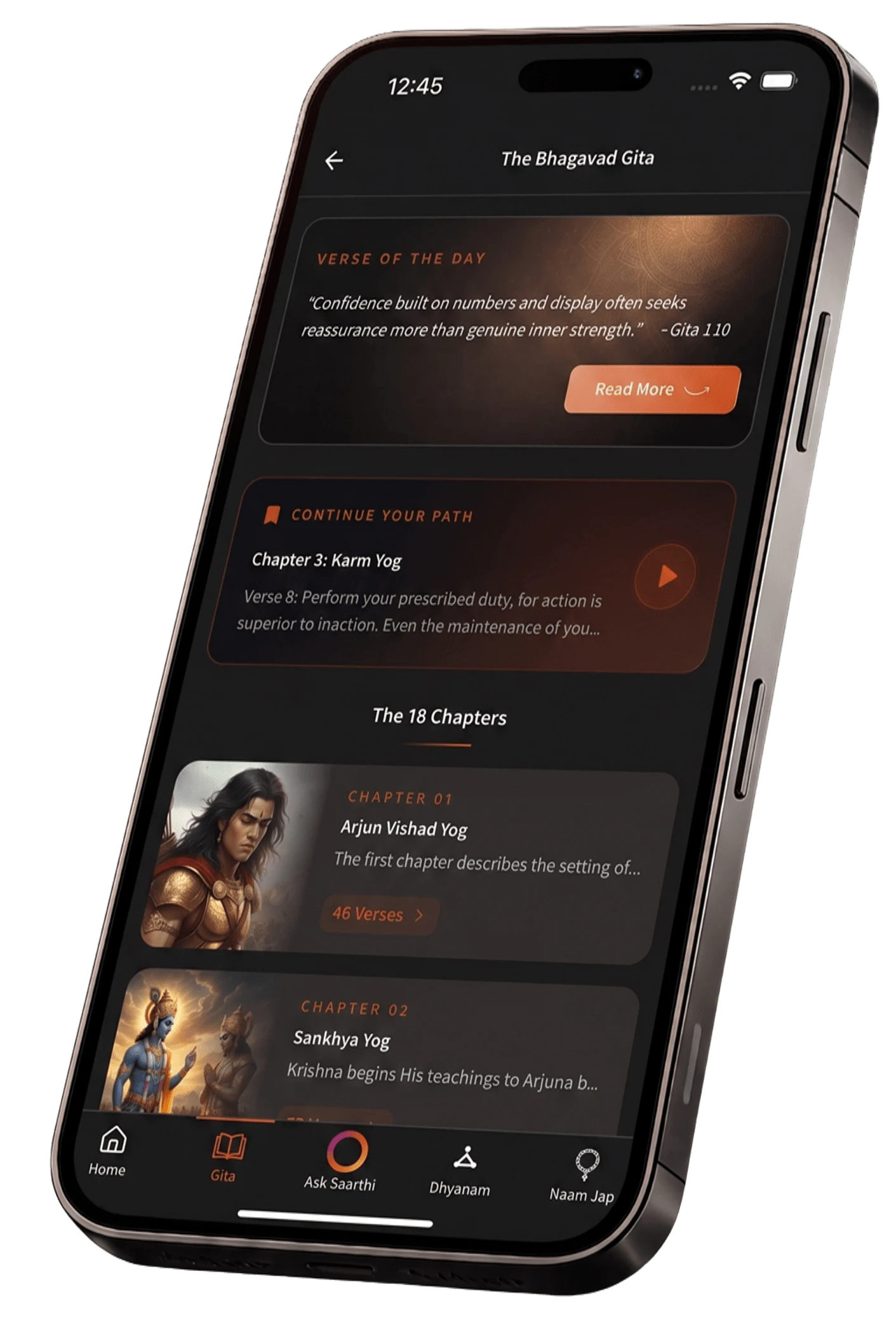
The Arutra app exists for exactly this: a daily practice of returning to who you are. Let Saarthi AI be the voice that cuts through the self-doubt stories with something real — the same way Krishna cut through Arjuna's.
Experience it on Arutra
Download the Arutra App
Guided Bhagavad Gita sessions, Bhagavad Gita verses, Saarthi AI, and more. Free on Android and iOS.