
Janmashtami falls on the Ashtami (eighth day) of the Krishna Paksha (dark fortnight) of the month of Bhadra in the Hindu calendar — typically August or September in the Gregorian calendar. It is observed with all-night vigils, devotional singing, fasting, and the celebrated Dahi Handi festival.
Janmashtami 2025 falls on August 16, 2025. Janmashtami 2026 falls on September 3, 2026.
But before the rituals, it is worth understanding what Janmashtami actually celebrates — and why it has been the most beloved festival in much of North India for over three thousand years.
The Birth of Krishna: The Story
Krishna was born at midnight in a prison cell in Mathura, to Devaki and Vasudeva. Devaki's brother, the tyrant Kamsa, had been told by a divine prophecy that Devaki's eighth child would be his slayer. He imprisoned the couple and killed their first seven children.
When Krishna was born — at the exact moment when the stars aligned in a specific configuration, which the astronomical tradition has preserved with remarkable precision — the guards fell asleep, the chains binding Vasudeva fell open, and the prison doors unlocked by themselves. Vasudeva carried the infant across the flood-swollen Yamuna river to Gokul, where he placed the child with Nanda and Yashoda and returned with their newborn daughter.
The symbolism here is layered:
Midnight birth: Krishna is born at the darkest moment — the darkest phase of the moon, the darkest hour of the night. The tradition understands this not as inconvenient timing but as the deepest teaching: the divine arrives when darkness is at its greatest. Joy is born in the middle of suffering. This is why Janmashtami is celebrated at midnight.
Prison: Consciousness (the divine) arrives even in the most restricted, oppressive conditions. Kamsa, who represents the ego and its tyrannical control, cannot ultimately contain what is divine.
The crossing of the Yamuna: Vasudeva carries the child through the raging river — a symbol of crossing the turbulent waters of samsara (worldly existence) to bring the divine to safety.
The switch: The divine is hidden in the ordinary, in the home of simple cowherd farmers. Krishna grows up not as a prince but as a gopala — a cowherd, a lover of music and play, deeply intimate with nature and community. This, too, is teaching.
Why Krishna's Birth Is Spiritually Significant
Of all the avatars in the Vaishnava tradition, Krishna is the most complete (purna avatar — the full descent of the divine). What makes this special is not just theological: it is that Krishna's life, as recorded across the Mahabharata, the Bhagavata Purana, and the Bhagavad Gita, covers the entire range of human experience and illuminates every dimension of it.
As an infant, he destroys demons while still in the cradle. As a young cowherd, he plays the flute and draws every living being toward him with love. As a young man, he defeats the tyrant Kamsa and liberates his parents. As a statesman and counselor, he navigates the complex politics of the Mahabharata. As a teacher, he gives the Bhagavad Gita — one of the most complete philosophical texts ever written — in the middle of a battlefield. As a friend, his relationship with Arjuna is the model of what deep friendship looks like.
This completeness is why the Bhagavad Gita — which is a direct teaching from Krishna — has such breadth. It is not the teaching of an ascetic removed from worldly life but of a being who has lived in the world completely, participated in it fully, and yet remained free from it.
Janmashtami celebrates the arrival of this being into human history.
Traditional Janmashtami Rituals
Fasting (Upavasa)
Most observant Hindus fast on Janmashtami until midnight — the hour of Krishna's birth. The fast may be complete (no food or water) or partial (fruit and milk allowed). The fast breaks at midnight with prasad — typically Panchamrit (a mixture of milk, yogurt, ghee, honey, and sugar) and fruits.
All-Night Vigil and Kirtan
Staying awake through the night, singing devotional songs (bhajans and kirtans) in praise of Krishna, is central to Janmashtami. The most beloved kirtan melodies associated with Janmashtami include settings of the Hare Krishna Mahamantra, Govinda Jai Jai, and poems from the Surdas bhajan tradition.
Jhula (The Swing)
Krishna is depicted on a jhula — a decorated swing — in many homes and temples. Rocking the swing while singing lullabies to the infant Krishna (particularly the poems of Surdas, which capture Yashoda's love for baby Krishna) is a beloved domestic ritual.
Bal Gopal Decoration (Abhishek)
An image or idol of baby Krishna (Bal Gopal or Laddu Gopal) is given a sacred bath (abhishek) with Panchamrit — milk, curd, ghee, honey, and sugar — then dressed in new clothes and placed in a decorated cradle. This abhishek is typically performed at midnight, recreating the moment of Krishna's birth.
Midnight Celebration
At midnight, the celebrations reach their peak: conch shells are blown, bells are rung, the abhishek is performed, and the assembled devotees offer flowers, lamps, and sweets to the newly "born" Bal Gopal.
Dahi Handi (Govinda)
Celebrated on the day after Janmashtami (Nandotsav), Dahi Handi commemorates Krishna's childhood fondness for butter and his habit of forming human pyramids with his friends to reach the pots of butter and curd that the gopis hung from the ceiling. A clay pot filled with butter and curd is hung high, and groups of young men (Govinda Pathaks) form human pyramids to break it. The festival is particularly associated with Maharashtra, where it has evolved into a major public celebration.
How to Celebrate Janmashtami at Home
You do not need a temple or an elaborate setup. A sincere home celebration can be deeply meaningful:
Set up a simple altar: Place an image or small idol of baby Krishna on a clean cloth. If you have a Laddu Gopal, dress him in new clothes for the occasion.
Draw tiny footprints: Using rice paste or chalk, draw small footprints from the entrance of your home toward the altar — symbolizing the arrival of Krishna.
Fast through the day: Even a partial fast (fruit and milk only) is sufficient for most households.
Sing bhajans: Play or sing Krishna bhajans through the evening. If you do not know any, the Hare Krishna Mahamantra is accessible to anyone.
Celebrate at midnight: Perform the abhishek of Bal Gopal with Panchamrit at midnight. Offer sweets and light the lamp. Break your fast with prasad.
Read the Gita: Janmashtami is an auspicious time to begin or deepen a Gita reading practice. Even reading one chapter on this day, with sincerity, is deeply meaningful.
The Inner Meaning of Janmashtami
Every Hindu festival has an outer form and an inner meaning. The inner meaning of Janmashtami is the birth of Krishna within the aspirant's own heart.
The yogic tradition understands the Gita's final promise — "I will liberate you from all sins; do not fear" (18:66) — as a description of what happens when Krishna is born within: when the divine awareness (which is Krishna's essential nature) is recognized as present in one's own consciousness. The prison is the conditioned mind. The midnight is the darkest moment of spiritual crisis. The birth is the moment of illumination.
This is why Janmashtami, even for non-devotional practitioners, marks something real: the possibility that even in the darkest circumstances, something divine can arise.
Janmashtami and the Bhagavad Gita
There is no better time to read or revisit the Bhagavad Gita than Janmashtami. The Gita is Krishna's direct teaching — the fullest expression of his wisdom and the most accessible window into the consciousness that Janmashtami celebrates.
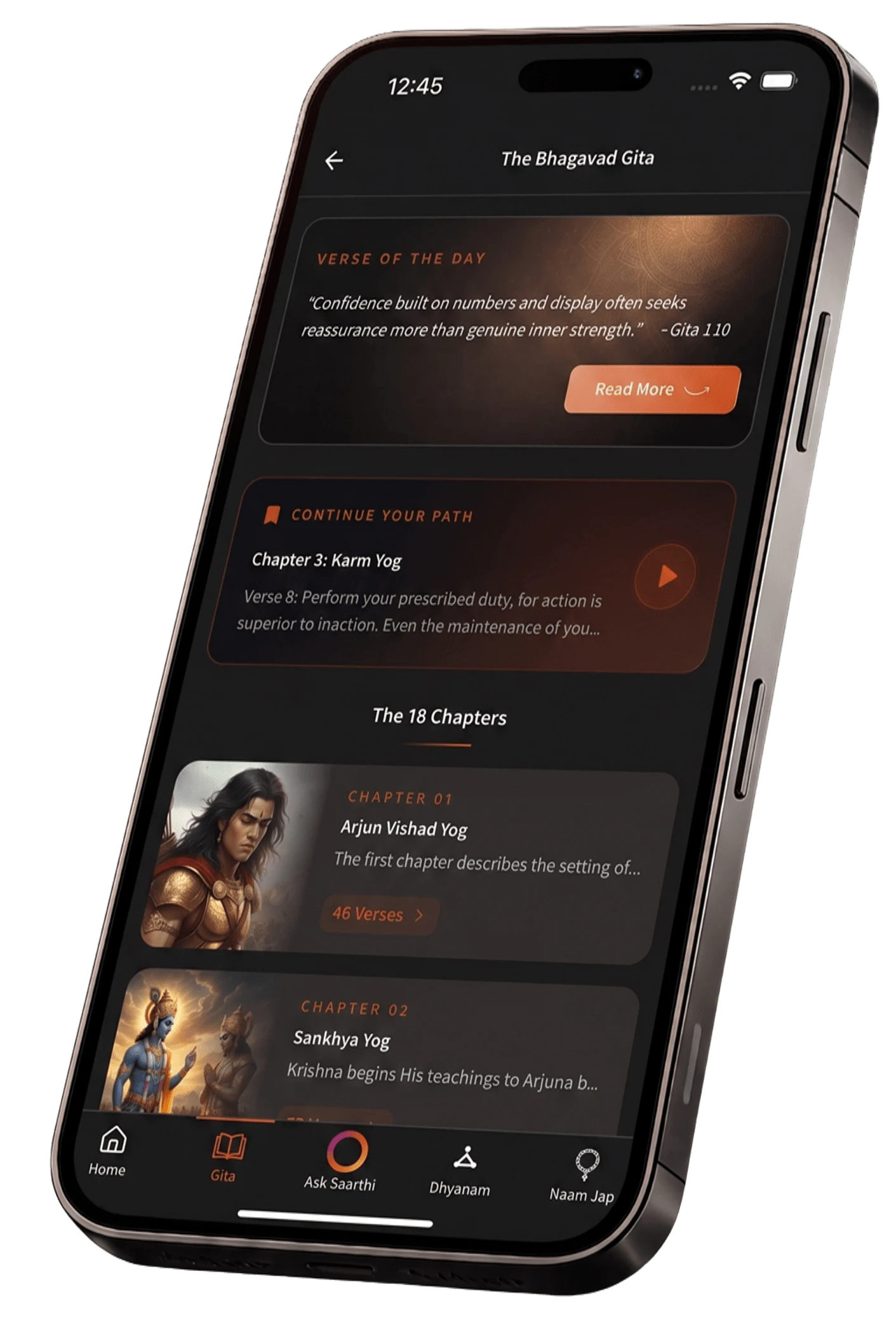
If you are beginning the Gita for the first time, Arutra's Gita Path presents all 18 chapters with Sanskrit, transliteration, and plain-language English explanations — designed for the modern reader who wants genuine understanding, not just a recitation of verses. Beginning on Janmashtami, with one chapter per day, brings you through the entire Gita in 18 days.
If you have questions about Krishna's teaching — what it means, how it applies to your life, why he says what he says — Saarthi AI on Arutra is there to explore them with you, using the Gita itself as the guide.
Jai Shri Krishna.
Experience it on Arutra
Download the Arutra App
Guided Bhagavad Gita sessions, Bhagavad Gita verses, Saarthi AI, and more. Free on Android and iOS.