
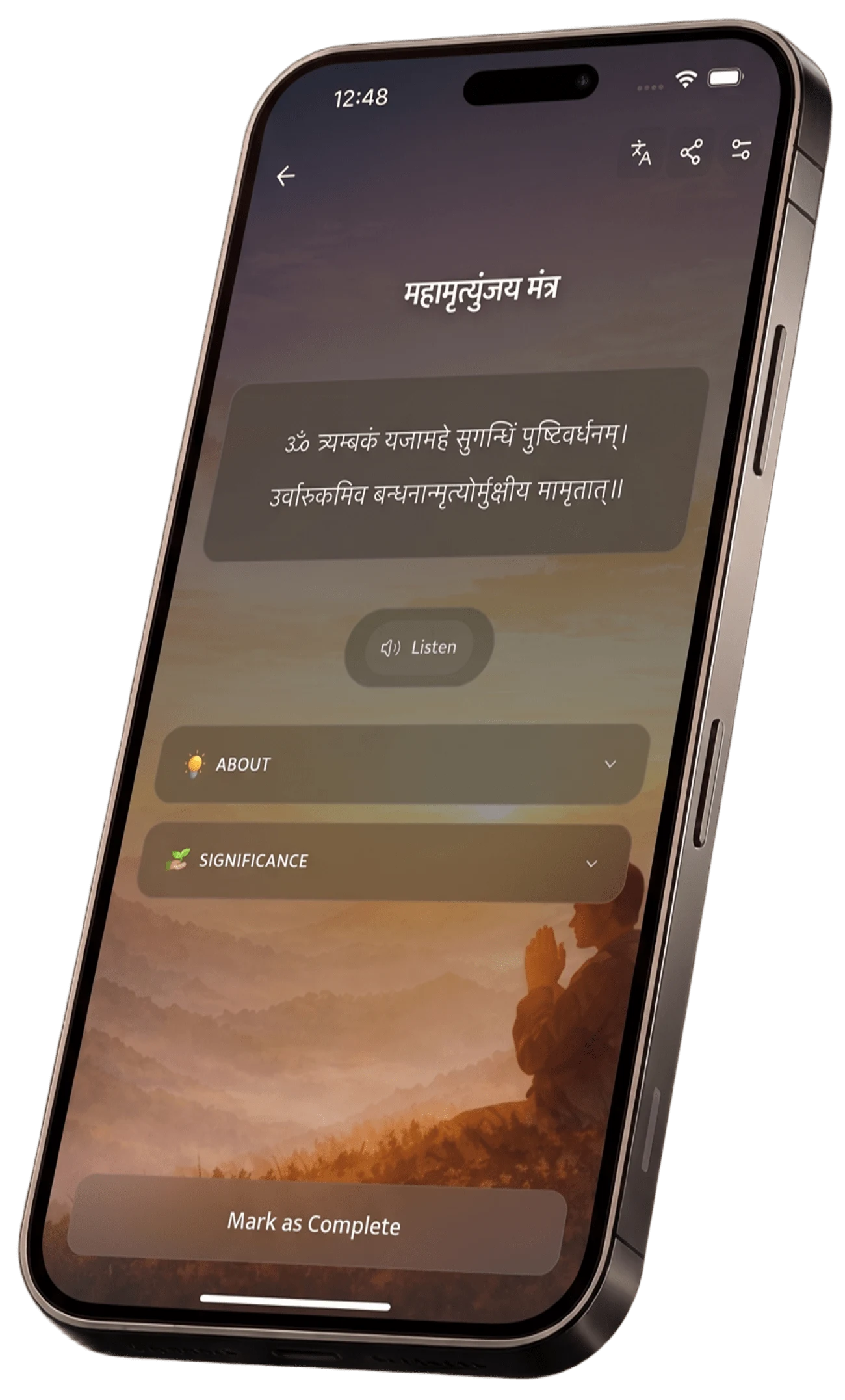
There is a reason the word "mantra" has entered modern English. It describes something that the Vedic tradition understood long before modern psychology confirmed it: the mind is deeply responsive to repeated sound, rhythm, and focused attention. The right mantra, practiced consistently, does something that willpower alone cannot — it gives the restless mind somewhere specific to go.
Here are the most effective mantras for peace of mind from the Vedic tradition, with their meanings and how to practice them.
Om (ॐ)
The most fundamental sound in the Vedic tradition. Om is considered the primordial sound from which all creation emerges. Chanting Om — a single sustained syllable that moves through the back of the throat (A), the chest (U), and closes at the lips (M) — produces a physical vibration that many practitioners describe as immediately calming.
How to practice: Sit comfortably with eyes closed. Inhale fully. On the exhale, chant Om slowly and sustained. Repeat for 5–10 minutes. The vibration of the sound itself is the practice — you don't need to think about its meaning while chanting.
Why it works for peace: The sustained exhalation involved in chanting Om activates the parasympathetic nervous system — the biological opposite of the stress response. This is not mystical; it is basic respiratory physiology, and it is why many contemplative traditions use sustained vocalization.
Om Shanti Shanti Shanti (ॐ शांति शांति शांति)
"Shanti" means peace in Sanskrit. This mantra invokes peace at three levels: peace of body (adhi-bhautika), peace of mind (adhi-daivika), and peace of spirit (adhi-atmika). It is chanted three times in many Vedic rituals precisely because peace needs to be established at all three levels.
How to practice: At the end of a meditation session or before sleep, chant Om Shanti three times slowly, allowing each "Shanti" to be a conscious intention for peace.
Om Namah Shivaya (ॐ नमः शिवाय)
This five-syllable mantra — Na, Ma, Shi, Va, Ya — dedicated to Lord Shiva is one of the most widely practiced mantras in India. Each syllable corresponds to one of the five elements: earth, water, fire, air, and ether. Meaning roughly "I bow to Shiva" or "I bow to the divine," it is associated with dissolution of ego and the calming of mental turbulence.
How to practice: Repeat during Naam Jaap with a mala (108 repetitions). The rhythmic repetition at a steady pace is the key. The Arutra app's Naam Jaap feature supports this mantra with a tap-to-count system.
Why it's especially effective for anxiety: The mantra's rhythm naturally slows breathing when spoken aloud at a measured pace, creating the same physiological calming effect as controlled breathing exercises.
Gayatri Mantra (गायत्री मंत्र)
Om Bhur Bhuvah Swah / Tat Savitur Varenyam / Bhargo Devasya Dhimahi / Dhiyo Yo Nah Prachodayat
This Vedic mantra from the Rigveda (3.62.10) invokes the divine light of the sun and asks that it illuminate the mind. It is traditionally chanted at sunrise and sunset, though modern practitioners chant it at any quiet moment.
How to practice: The Gayatri is ideally chanted 108 times in a single sitting. Learn the correct pronunciation first — there are many recordings available. Mental recitation (without sound) is equally valid once the mantra is internalized.
Why it works: The Gayatri mantra is a prayer for discernment — for the mind to see clearly rather than through the distortions of anxiety, projection, or desire. Practitioners report that sustained practice over weeks and months shifts the quality of attention in daily life, not just during the chanting itself.
Soham (सोऽहम्)
"So" on the inhale, "Ham" on the exhale. This mantra aligns with the natural rhythm of breathing and means "I am That" — an affirmation of identity with the universal consciousness. Unlike other mantras, Soham is practiced silently, synchronized exactly with the breath.
How to practice: Close your eyes. Without changing your natural breathing, simply observe each breath and mentally note "So" on the inhale and "Ham" on the exhale. Continue for 10–20 minutes. Thoughts will arise; return to the breath and the mantra without frustration.
Why it's ideal for anxiety: Because Soham uses the breath as its anchor, it is impossible to hyperventilate or lose the breath. It is also more accessible for people who find audible chanting uncomfortable or impractical in their environment.
A Note on Consistency
None of these mantras work as a one-time intervention. The Bhagavad Gita (Chapter 6) is explicit on this point: the mind is controlled not by a single effort but by consistent practice (abhyasa) and non-attachment (vairagya). The results of mantra practice accumulate over time, not immediately.
Start with one mantra. Practice it daily for 40 days — a traditional period considered sufficient to establish a habit. Track your practice with Arutra's Naam Jaap feature, which lets you log daily repetitions and build streaks. Small actions, done consistently, are the foundation.
Experience it on Arutra
Download the Arutra App
Guided Meditation sessions, Bhagavad Gita verses, Saarthi AI, and more. Free on Android and iOS.