
Almost everyone who has tried meditating knows that the first week tends to go well. It is the second month that sorts out who will continue. The challenge is not motivating yourself to begin. It is building the kind of habit structure that carries the practice through inevitable disruptions: travel, illness, busy periods, loss, and the plain difficulty that arises when the novelty has worn off and the practice must sustain itself on its intrinsic merit.
Anchoring to an Existing Routine
The most effective way to build any new habit is to anchor it to something you already do every day. For most people, this means meditating first thing in the morning, before the day has generated its own momentum. The classical guidance is consistent with this: the hours before sunrise are considered ideal precisely because the mind has not yet been pulled into the day's activities. But even if morning is not possible, tying meditation to an existing anchor (after morning tea, before bed, immediately after a work commute) dramatically increases follow-through.
The Environment Matters
A designated meditation space, however small, changes the quality of the practice. When you sit in the same spot, at the same time, your nervous system begins to associate that place with stillness. The transition into meditation becomes shorter. The quality of silence deepens more quickly. Even a cushion placed in a specific corner of a room, returned to daily, starts to carry this quality over time.
Dealing with Missed Days
Missing a day is not the problem. Missing ten days in a row because you felt you had failed after missing one day: that is the pattern that ends practices. The tradition is realistic about this. The Yoga Sutras acknowledge that abhyasa (practice) must be sustained over a long time, without interruption, and with earnestness. But when interruption happens, the instruction is simply to return. Not to analyze why you stopped, not to make dramatic new commitments. Simply to sit again.
How the Practice Deepens Over Time
In the first weeks, the main challenge is distraction. In the first months, the main challenge is boredom. Boredom in meditation is a sign that the gross distractions have settled and you are encountering the subtler layers of mental resistance. This is actually progress. As practice deepens over a year or more, you begin to notice changes that do not announce themselves as meditation experiences. You simply find yourself responding differently, being less knocked around by circumstance, carrying a quality of ease that was not there before.
The Role of Community and Teacher
The tradition has always taught that sadhana (spiritual practice) is strengthened by satsang (community of practitioners). Even if you practice alone, connecting periodically with others who meditate, whether through a local group, an online community, or simply a friend who also practices, provides accountability and an external reference point for the inner journey.
Sadhana as a Lifelong Commitment
The goal of daily meditation is not a specific number of minutes or a particular state of mind. It is the gradual transformation of your default relationship with your own awareness. This transformation does not happen in weeks. It happens over years. The tradition describes this with the metaphor of water flowing over stone: no single drop of water moves the stone, but the cumulative effect of consistent flow reshapes the landscape.
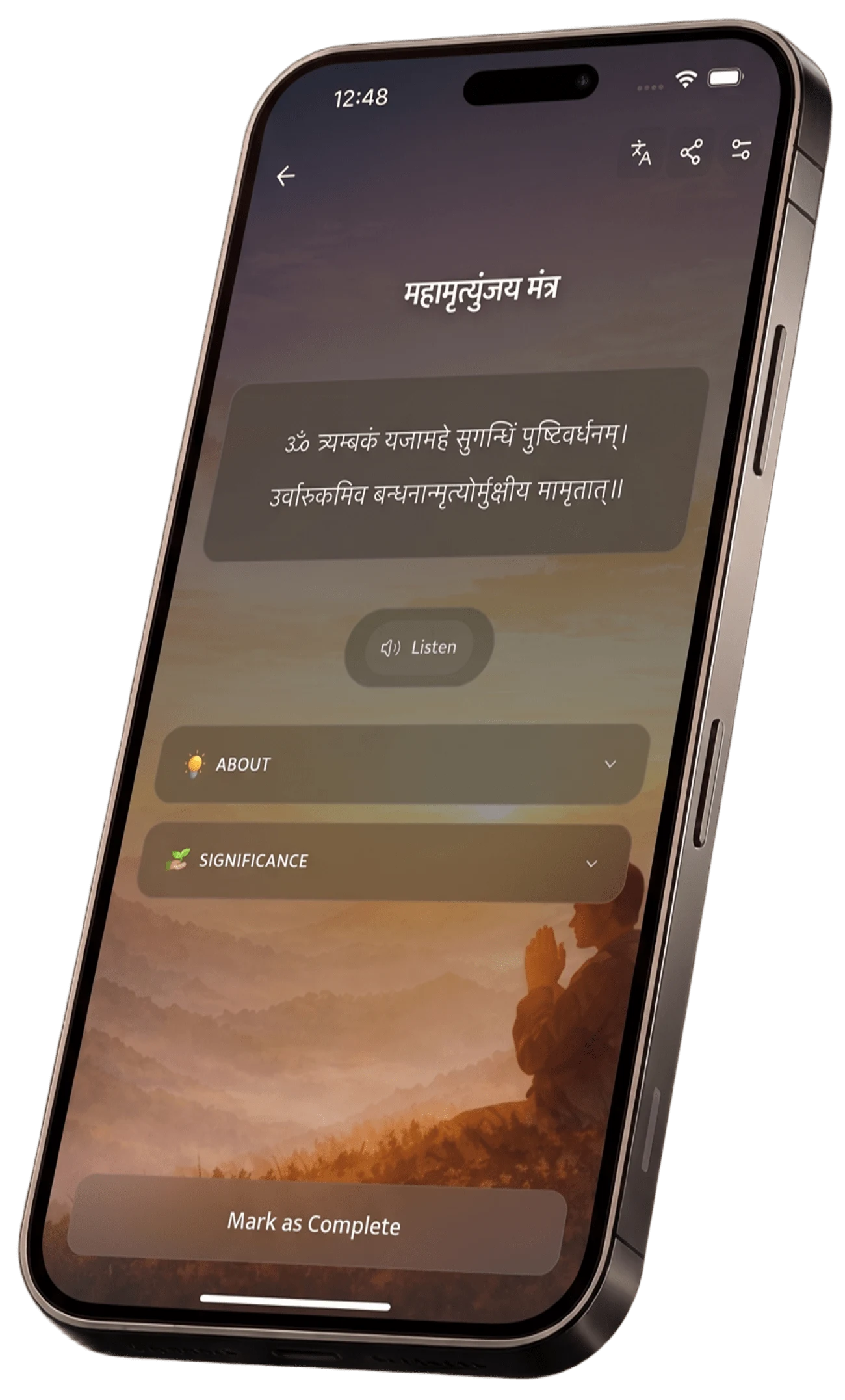
The Arutra app is designed to be a long-term companion for exactly this journey, with session tracking, gradual deepening practices, and gentle reminders that support consistency without rigidity.
Experience it on Arutra
Download the Arutra App
Guided Meditation sessions, Bhagavad Gita verses, Saarthi AI, and more. Free on Android and iOS.