
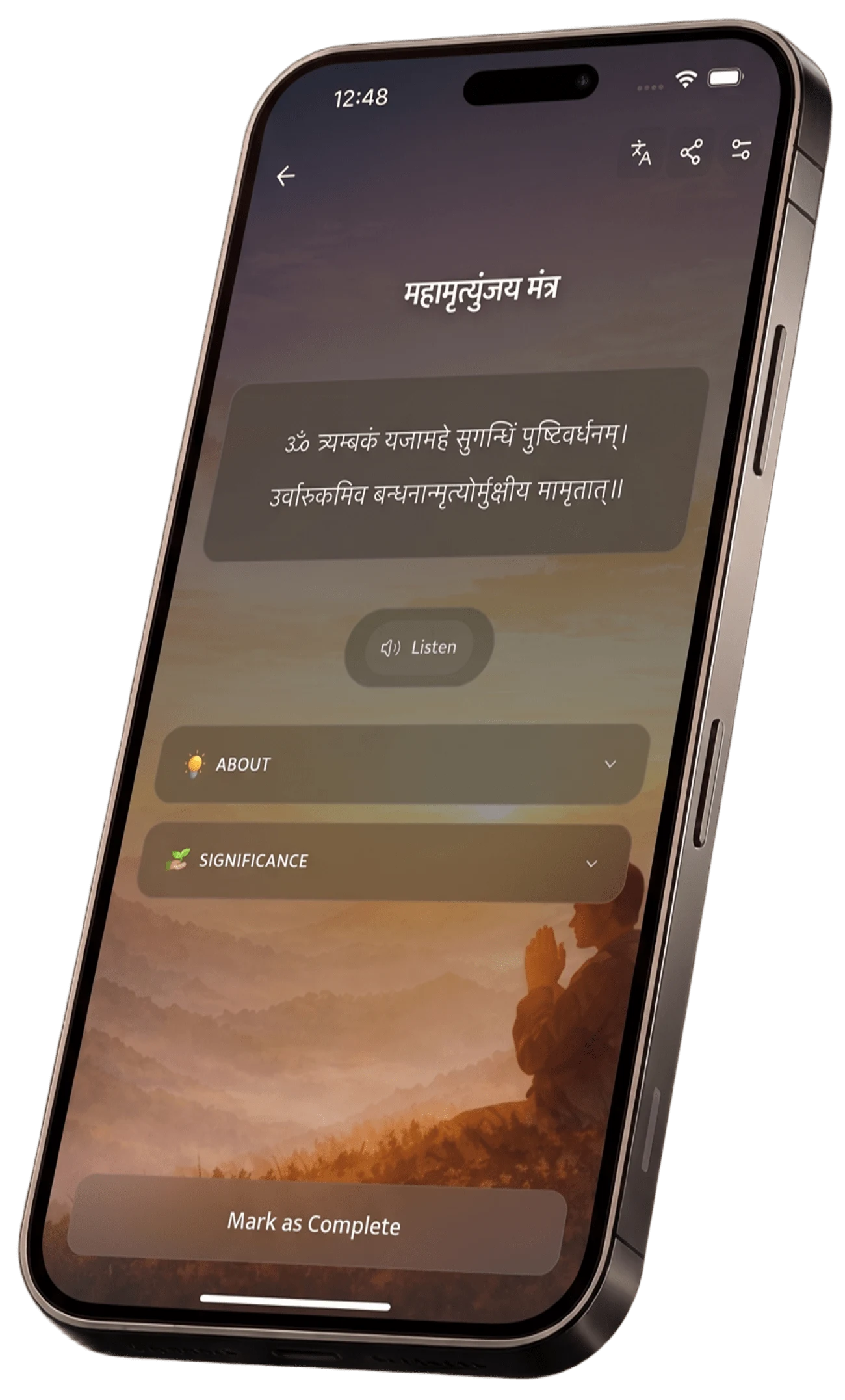
The Mahamrityunjaya Mantra is one of the oldest mantras in recorded human history. It appears in the Rig Veda (7.59.12), the Yajur Veda, and is elaborated upon extensively in the Shiva Purana. Its age alone commands respect, but its continued vitality across thousands of years suggests that it touches something perennially true about the human encounter with mortality, illness, and the desire for wholeness.
Word by Word
The full mantra reads: Om Tryambakam yajamahe sugandhim pushtivardhanam, Urvarukamiva bandhanan mrityor mukshiya maamritat. Tryambakam: the three-eyed one, Lord Shiva, whose third eye represents wisdom that sees beyond the duality of life and death. Yajamahe: we worship, we adore. Sugandhim: the sweet fragrance, referring both to physical vitality and to the quality of goodness. Pushtivardhanam: he who nourishes and increases abundance. Urvarukamiva: like a ripened cucumber or fruit. Bandhanan: from bondage. Mrityor: from death. Mukshiya: liberate us. Maamritat: grant us liberation.
The Ripened Fruit Metaphor
The image of the ripened fruit separating naturally from the vine is one of the most poignant metaphors in any mantra. The prayer does not ask that death be avoided. It asks that when death comes, it come as a natural release rather than a violent severing, the way a ripe fruit falls effortlessly rather than being torn off. The deepest petition in this mantra is not for physical immortality but for liberation from the fear of death.
When This Mantra Is Chanted
In practice, the Mahamrityunjaya Mantra is chanted in many contexts. During serious illness, whether of oneself or of a loved one, it is chanted to invoke healing and divine grace. During times of great fear or crisis, it is a refuge. In the context of daily spiritual practice, it is used as a mantra for deepening the understanding of one's relationship with the mortal body and the immortal self within it.
Traditional Practice
Traditional guidance suggests chanting this mantra 108 times per sitting, ideally in the Brahma Muhurta or during significant moments of the day. It is also common to chant it while offering water to a Shiva Linga or while lighting a lamp.
What Practitioners Report
One of the most common experiences reported by practitioners is a quality of steadiness that comes with regular chanting of this mantra. The explicit confrontation with mortality that the mantra engages tends to paradoxically reduce the low-level anxiety about death and loss that shadows much of ordinary life. What is named and faced loses some of its power to frighten.
The Arutra app includes a dedicated Mahamrityunjaya Mantra practice section with audio guidance, syllable-by-syllable pronunciation support, and session tracking.
Experience it on Arutra
Download the Arutra App
Guided Praarthana sessions, Bhagavad Gita verses, Saarthi AI, and more. Free on Android and iOS.