Breath is the one bodily function that operates both consciously and unconsciously. You breathe while asleep. You breathe without thinking. But you can also choose to breathe — to slow down, to deepen, to hold. This dual nature is what makes the breath uniquely powerful as a tool for inner work.
The yogic tradition identified this thousands of years ago. Pranayama — from prana (life force, breath) and ayama (extension, expansion, restraint) — is the systematic science of working with breath to influence the state of the mind and the quality of awareness.
This guide covers five classical pranayamas. They are presented in order of accessibility, from simplest to more advanced.
Before You Begin
Posture: Sit in any position where your spine can be comfortably upright. Sukhasana (easy cross-legged), Padmasana (lotus), Vajrasana (kneeling), or sitting in a chair with feet flat on the floor — all work. The spine should be erect but not rigid.
Timing: Morning on an empty stomach is traditional. Ideally, at least 3–4 hours after eating for more intensive practices. A light practice (like Nadi Shodhana) can be done anytime.
Duration: Begin with 5–10 minutes per session. Build gradually. Quality and consistency matter more than duration.
Caution: If you have heart conditions, respiratory issues, high blood pressure, or are pregnant, consult a physician before beginning pranayama. Avoid breath retention (kumbhaka) practices initially.
1. Natural Breath Awareness (Sahaja Pranayama)
This is not technically a pranayama but is the essential starting point.
Sit comfortably. Close your eyes. Without changing anything, simply observe your natural breath for 3–5 minutes. Notice: Where does the breath enter the body — nostrils, chest, belly? Is the inhale longer than the exhale, or vice versa? Is the breath smooth or jagged? Are there pauses?
This observation, done sincerely, reveals a great deal about your current state. Anxiety produces short, shallow chest breathing. Calm produces long, abdominal breathing. By watching the breath, you are also watching the mind.
Why start here: You cannot change what you cannot see. This practice develops the sensitivity to breath that makes all other pranayamas more effective.
2. Diaphragmatic Breathing (Adham Pranayama)
Also called belly breathing or abdominal breathing.
Place one hand on your belly and one on your chest. Inhale slowly through the nose, directing the breath into the belly — the hand on your stomach should rise while the hand on your chest remains relatively still. Exhale slowly, the belly falling. Aim for a 4-count inhale and 6-count exhale.
Start with 10 rounds and build to 5–10 minutes.
Why it works: Most adults breathe from the upper chest — a pattern reinforced by stress, poor posture, and sedentary habits. Shallow chest breathing activates the sympathetic nervous system (the stress response). Diaphragmatic breathing activates the parasympathetic nervous system (the rest-and-digest response). This is not folk wisdom; it is well-established physiology.
When to use it: Whenever you feel anxious, reactive, or mentally scattered. It is also a good starting practice before any meditation session.
3. Nadi Shodhana (Alternate Nostril Breathing)
Nadi Shodhana means "channel purification." Nadis are the subtle energy channels (described in yogic anatomy) through which prana flows; Shodhana means purification or cleansing.
How to do it:
- Sit with spine upright. Use your right hand, placing the thumb on the right nostril and the ring finger on the left. Index and middle fingers can rest on the forehead or be folded toward the palm.
- Close the right nostril with your thumb. Inhale through the left nostril for 4 counts.
- Close both nostrils. Hold briefly (optional for beginners).
- Release the thumb, close the left nostril with your ring finger. Exhale through the right nostril for 6–8 counts.
- Inhale through the right nostril for 4 counts.
- Close both nostrils again. Hold briefly.
- Release the ring finger. Exhale through the left nostril for 6–8 counts.
This is one complete cycle. Do 5–10 cycles to start.
Why it works: The two nostrils are associated in yogic physiology with the ida (left, cooling, lunar) and pingala (right, heating, solar) nadis. Alternate nostril breathing is said to balance these two channels, creating a state of equilibrium. Modern research has found that nasal airflow alternates naturally between nostrils in a cycle, and that each nostril is associated with greater activation of the contralateral brain hemisphere. Alternate nostril breathing appears to produce a more balanced neurological state.
Benefits: Reduced anxiety, improved focus, better sleep when practiced before bed, a general sense of calm clarity.
4. Bhramari Pranayama (Humming Bee Breath)
Bhramari comes from Bhramara, the black bee. The practice involves making a soft humming sound on the exhale, like the drone of a bee.
How to do it:
- Sit comfortably. Optional: close your ears gently with your thumbs, place index fingers lightly on the forehead above the eyebrows, and cover your eyes with the remaining fingers (this is called Shanmukhi Mudra).
- Inhale through the nose.
- Exhale slowly, making a sustained humming sound — "mmmm" — for the full duration of the exhale. The sound should be smooth and even.
- Repeat 5–10 times.
Why it works: The humming sound creates internal vibration, particularly resonating in the sinus cavities and skull. This stimulates the vagus nerve and triggers the relaxation response. Research has found that humming significantly increases nasal nitric oxide — a molecule that plays a role in regulating inflammation, blood pressure, and the immune response.
Particularly effective for: Agitation, anger, insomnia, headaches, and the kind of "busy mind" that makes it hard to settle into meditation. Many practitioners find Bhramari more immediately calming than any other pranayama.
5. Anulom Vilom (Ratio Breathing with Retention)
This is a more advanced form of alternate nostril breathing that introduces retention (kumbhaka). Begin only after you are comfortable with basic Nadi Shodhana.
The classic ratio is 1:4:2 — inhale, hold, exhale in a 1:4:2 ratio. A common starting point is 4:16:8 (4 counts inhale, 16 hold, 8 exhale).
How to do it:
- Use the same nostril hand position as Nadi Shodhana.
- Inhale through the left nostril for 4 counts.
- Hold both nostrils closed for 16 counts.
- Exhale through the right nostril for 8 counts.
- Inhale through the right nostril for 4 counts.
- Hold for 16 counts.
- Exhale through the left nostril for 8 counts.
This is one cycle. Begin with 3–5 cycles.
Important: Never strain during retention. If 16 counts feels uncomfortable, reduce to 8 or even 4. The ratio matters more than the absolute duration. Work up slowly over weeks and months.
Why it works: Breath retention increases CO2 in the blood, which the body interprets as a signal to increase oxygen delivery to the brain. The periods of retention also allow a natural stilling of mental activity — it is difficult to think actively while you are holding your breath in a focused way. Over time, the capacity for retained, extended, controlled breath is associated in the yogic tradition with significant improvements in concentration and reduced reactivity.
Building a Pranayama Practice
For most beginners, a practical starting sequence is:
- 3 minutes of natural breath awareness
- 5 minutes of diaphragmatic breathing
- 5 minutes of Nadi Shodhana
- 3 minutes of Bhramari to close
This 16-minute sequence can be done daily, ideally before morning meditation. As your practice deepens, introduce retention and extend the durations.
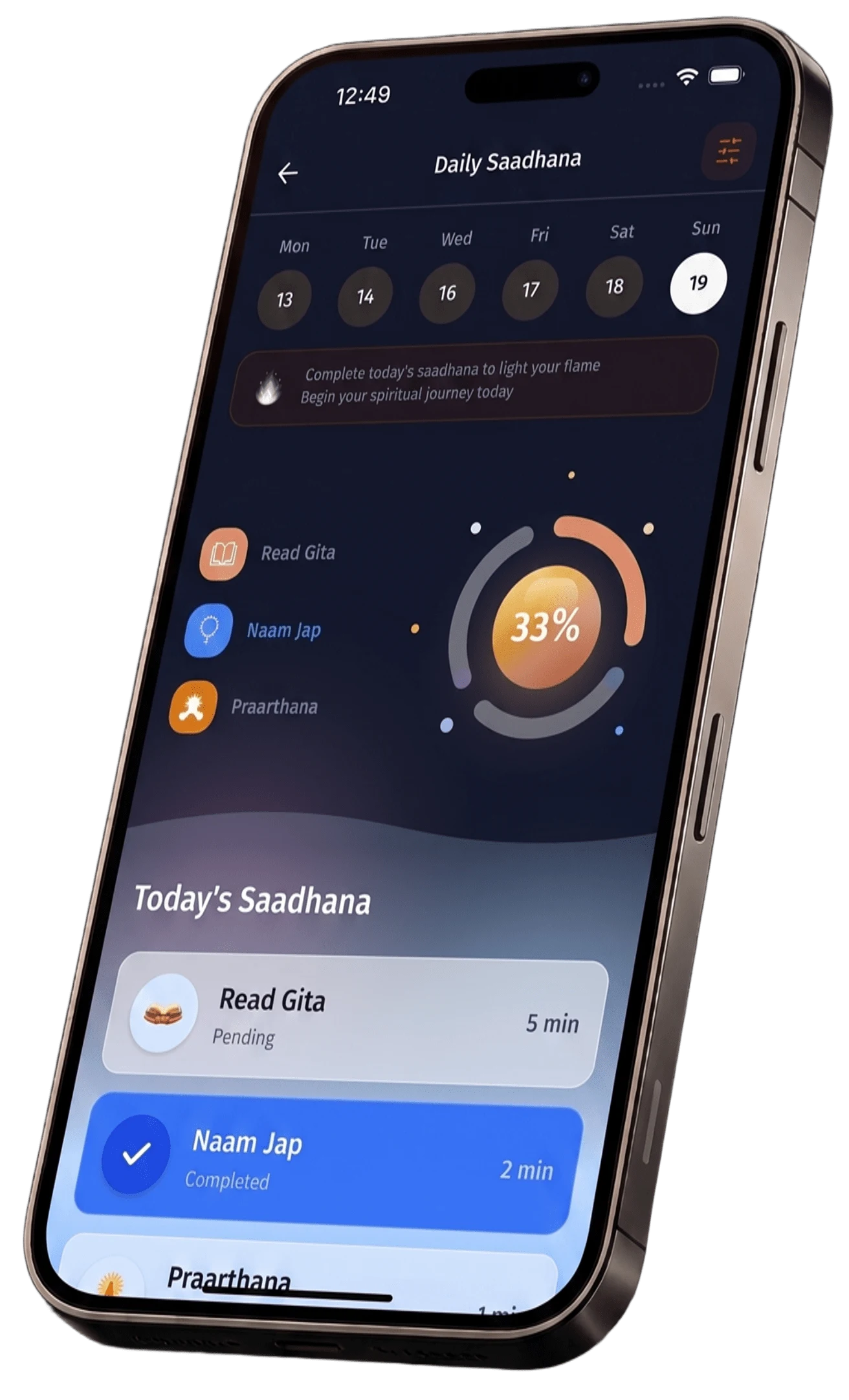
Arutra's Daily Sadhana feature is designed for exactly this kind of tracking — log your pranayama sessions alongside your Naam Jaap, Gita reading, and other practices. Seeing your daily consistency builds the habit loop that makes showing up easier over time.
Experience it on Arutra
Download the Arutra App
Guided Meditation sessions, Bhagavad Gita verses, Saarthi AI, and more. Free on Android and iOS.