
The Bhagavad Gita holds a remarkable place in world literature. Spoken on a battlefield, in the middle of a crisis that the protagonist found psychologically paralyzing, it addresses questions that remain entirely alive today: how do you act rightly when the situation is genuinely difficult? How do you maintain equanimity when the outcome is uncertain?
The Gita's Enduring Relevance
Scholars, philosophers, and spiritual teachers across centuries have offered interpretations of the Gita, and these interpretations differ substantially. Shankaracharya read it through the lens of Advaita Vedanta, emphasizing jnana as the primary path. Ramanujacharya read it as a text of Vishishtadvaita, emphasizing loving devotion. Bal Gangadhar Tilak read it as a call to selfless action. Each reading illuminates something genuine in the text.
The Challenge of Many Interpretations
For the modern reader approaching the Gita without a teacher, this diversity can feel overwhelming. Which translation should you read? Whose commentary is reliable? And when you do read a verse, how do you know whether you are understanding it correctly?
How Dialogue Helps
This is where an AI guide becomes genuinely useful. Rather than reading a static commentary, you can engage with the Gita's verses in dialogue. You can ask what Krishna means in verse 2.47 when he says you have a right to action but not to its fruits. And receive a response that explores the nuance: the distinction between detachment from results as an egoic strategy and detachment as a natural outcome of acting from your deepest values.
Applying the Gita to Real Life
You can ask follow-up questions. You can challenge the response. You can bring in your specific situation. A good AI guide can help you move from abstract understanding to something that actually illuminates your life. It can help you navigate the vast commentary tradition without getting lost in it.
Navigating the Commentary Tradition
Mention that you are interested in the devotional reading, and it can draw from Ramanuja and the Bhakti school. Mention that you come from a scientific background and want to reconcile the Gita with modern psychology, and it can help you explore that bridge.
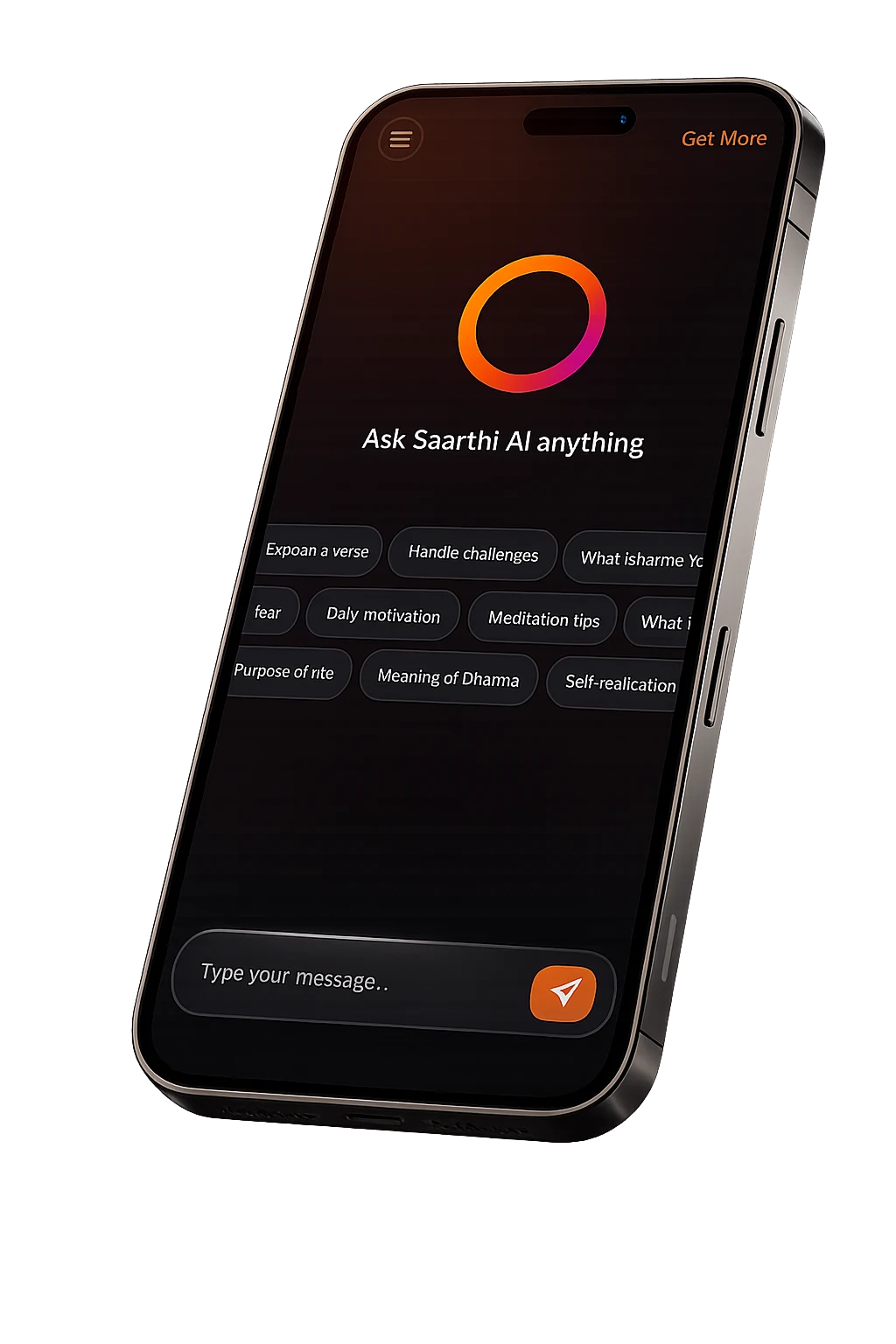
The Arutra app's Saarthi AI is built with the Bhagavad Gita as one of its core knowledge foundations, allowing you to explore any chapter, any verse, and any theme in depth, at your own pace, with a guide that meets you where you are.
Experience it on Arutra
Download the Arutra App
Guided Saarthi AI sessions, Bhagavad Gita verses, Saarthi AI, and more. Free on Android and iOS.