
Spiritual seekers across India have always valued access to a knowledgeable guide. In villages, this role was filled by the local pandit or sadhu. In cities, people attended satsangs or kept books by revered teachers on their shelves. The tradition of asking questions and receiving guidance is as old as the Upanishads themselves, which are structured precisely as dialogues between curious students and patient teachers.
The Gap That AI Fills
The emergence of AI has made a new kind of guide possible, one that does not replace the human teacher but fills a gap that human teachers, no matter how dedicated, cannot always fill: the gap of immediate availability. It is three in the afternoon and a thought about karma and free will has been nagging at you since morning. You cannot call your teacher. The satsang is on Sunday. But the question is alive right now, and you want to explore it.
What a Spiritual AI Does
This is the space an AI spiritual guide occupies. A well-designed spiritual AI is not a general-purpose chatbot that happens to have read some scriptures. It is a tool built specifically to engage with questions that arise at the intersection of daily life and spiritual understanding. Questions like: Why does the Gita say desire is the root of suffering, but also say to act without renouncing action? How do I understand karma when genuinely terrible things happen to genuinely good people?
What It Does Not Do
A good spiritual AI does not pretend to have the experiential authority of a realized teacher. That would be dishonest and counterproductive. What it can do is bring together a wide range of scriptural perspectives, explain them clearly, note where traditions differ, and help you think through how an idea might apply to your actual situation. Think of it less like a guru and more like a very well-read, endlessly patient study companion.
What Human Teachers Offer That AI Cannot
The relationship with a human teacher carries dimensions that no AI can replicate: the transmission of presence, the trust built over years, the teacher's ability to read what the student actually needs rather than what the student thinks they need. These remain irreplaceable. But they are also not available at every moment of the day, and many seekers go through long periods without access to a qualified teacher at all.
For Those Who Are Shy to Ask
An AI spiritual guide is also particularly useful for people who feel shy about asking what they fear are "basic" questions in a group setting. The tradition has many terms and concepts that are rarely explained clearly, and the fear of appearing ignorant can prevent someone from asking the very question that might unlock a much deeper engagement with the practice.
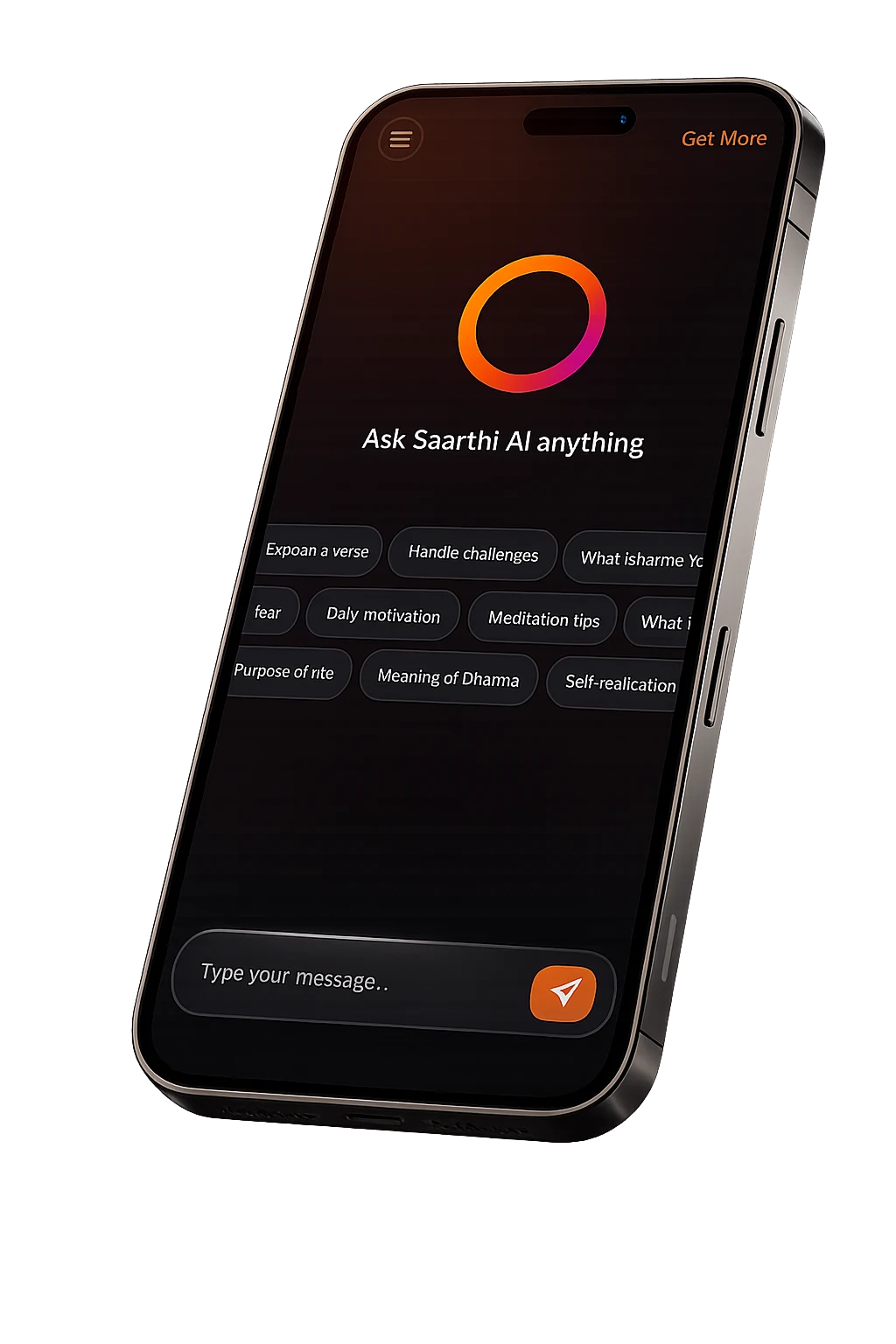
The Arutra app's Saarthi AI is designed with exactly this spirit in mind: a knowledgeable, non-judgmental presence that helps you engage with the vast wealth of India's spiritual tradition, one question at a time, wherever you happen to be.
Experience it on Arutra
Download the Arutra App
Guided Saarthi AI sessions, Bhagavad Gita verses, Saarthi AI, and more. Free on Android and iOS.