
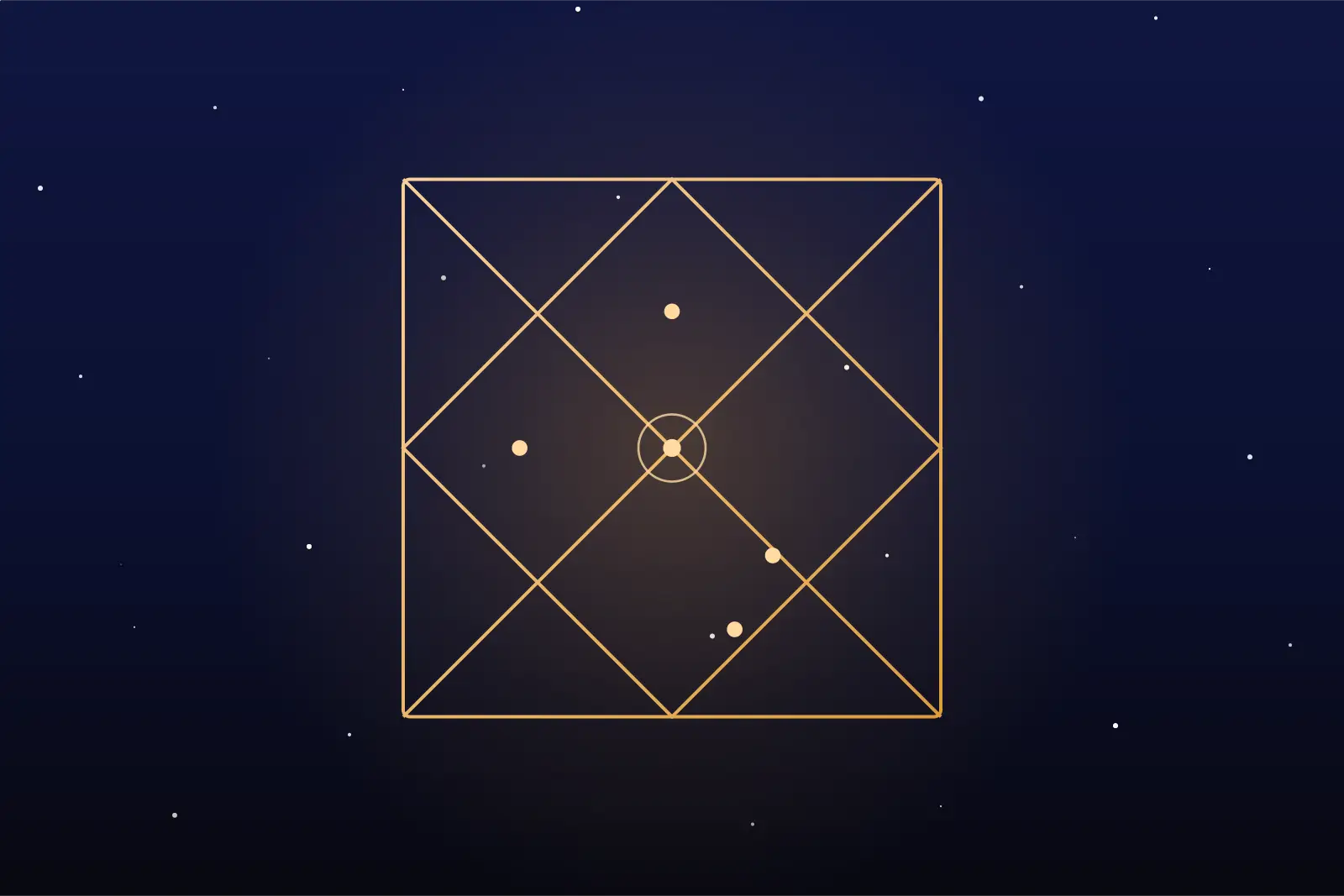
If you have ever seen your kundali, you probably remember a square grid filled with numbers, Sanskrit abbreviations, and symbols that nobody around you could fully explain. For most people, the kundali remains exactly that: a document consulted at birth and at marriage, and a mystery the rest of the time. Yet the idea behind it is remarkably simple.
A Photograph of the Sky
A janam kundali (birth chart) is a map of where the Sun, the Moon, and the planets were positioned in the sky at the exact moment and place of your birth. That is all it is. Change the time by a few hours or the city by a few hundred kilometres, and the map changes. This is why Vedic astrologers always ask for three things: date of birth, time of birth, and place of birth. Together they freeze a single moment of the sky, and that frozen moment is your chart.
The Three Building Blocks
Every kundali is built from three elements. The twelve signs (rashis) are segments of the sky, from Mesha (Aries) to Meena (Pisces). The nine planets (grahas) of Jyotish are the Sun, Moon, Mars, Mercury, Jupiter, Venus, Saturn, and the two lunar nodes, Rahu and Ketu. And the twelve houses (bhavas) are areas of life: the self, wealth, siblings, home, children, health, partnership, transformation, fortune, career, gains, and liberation. Reading a chart means asking one question again and again: which planet sits in which sign, in which house?
The Lagna: Where Your Chart Begins
The lagna, or ascendant, is the sign that was rising on the eastern horizon at the moment you were born. It fixes the layout of your entire chart, because the rising sign becomes your first house and everything else follows from there. The lagna changes roughly every two hours, which is why birth time matters so much, and why two people born on the same day can have very different charts.
Your Rashi: The Moon Sign
In Vedic astrology, when someone asks your rashi, they mean your Moon sign: the sign the Moon occupied at your birth. The Moon represents the mind and emotions, so Jyotish treats it as the centre of your inner life. Your daily and monthly horoscopes in the Vedic system are read from the Moon sign, not the Sun sign you know from magazine columns.
What a Kundali Can and Cannot Tell You
A kundali describes tendencies, strengths, and timings. It can show where your energy flows easily and where you may face friction, and systems like the dashas suggest when different themes of life become active. What it does not do is fix your fate. The tradition itself says the chart shows the terrain, not the route you must take. A good reading leaves you feeling clearer and more capable, never frightened.
Reading Yours Without a Dictionary
The hardest part of Jyotish has never been the ideas; it is the presentation. Grids, abbreviations, and Sanskrit terms make a simple map look like an exam. Arutra Astro generates your kundali from your birth details using classical Vedic calculations, then explains it finding by finding in plain language: what your lagna says about how you meet the world, what your Moon sign says about your inner weather, and where your chart carries natural strength. You can also ask Jyotish AI any question about your chart in chat, the way you would ask a family astrologer.
Experience it on Arutra
Download the Arutra App
Guided Astro sessions, Bhagavad Gita verses, Saarthi AI, and more. Free on Android and iOS.

