
The Gayatri Mantra is 24 syllables. It is found in the Rigveda (3.62.10), composed by the sage Vishwamitra. Tradition holds that it was not invented but revealed — that it encodes something about the relationship between human awareness and the light of cosmic intelligence that cannot be improved upon.
The full mantra:
Om Bhur Bhuvah Swah
Tat Savitur Varenyam
Bhargo Devasya Dhimahi
Dhiyo Yo Nah Prachodayat
This is usually preceded by the Vyahriti (the three great utterances) and the pranava (Om). Let us go through every word.
The Pranava and Vyahriti
Om (ॐ) — The primordial sound. Om is not a word in the ordinary sense — it is the sound that the Vedic tradition associates with the totality of existence, before it differentiates into the sounds of language. Chanting Om at the start aligns the practitioner with this ground before beginning the prayer.
Bhur (भूर्) — The physical world; the earth plane; the realm of matter and bodies.
Bhuvah (भुवः) — The intermediate world; the vital or subtle realm; the realm of breath and life force (prana). Sometimes translated as "sky" or "atmosphere."
Swah (स्वः) — The heavenly realm; the celestial or causal world; the realm of pure intelligence and light.
Together, these three — Bhur, Bhuvah, Swah — represent all three planes of existence: gross, subtle, and causal. The practitioner is not just inhabiting the physical body but is aware of their presence across all three dimensions of being.
The Core Mantra: Word by Word
Tat (तत्) — "That." The demonstrative pronoun pointing toward the divine reality — not "this" (here, accessible) but "That" (transcendent, beyond the ordinary reach of language). In the Upanishads, "Tat" is the same word used in the Mahavakya "Tat tvam asi" — "That thou art."
Savitur (सवितुर्) — Genitive form of Savitri or Savitu. Savitu means "the Vivifier" or "the One who generates and illuminates." It refers to the Sun — not just the physical sun, but the solar principle of divine light and intelligence that animates all of creation. The Vedas understood the sun as more than a star: it is the outer manifestation of the inner light of consciousness.
Varenyam (वरेण्यम्) — "Worthy of worship," "most excellent," "chosen above all others." From the root vr, meaning to choose or select. Varenyam is the superlative: this light is the one thing most worthy of being sought above all else.
Bhargo (भर्गो) — Often translated as "divine radiance," "spiritual brilliance," or "purifying light." Bharga is the light that burns away ignorance — not merely illuminating, but transforming. This is the light that purifies the mind.
Devasya (देवस्य) — "Of the divine," "of the god," "of the shining one." Deva comes from div, meaning to shine. Devasya is the genitive: "of that divine, shining intelligence."
Dhimahi (धीमहि) — First person plural imperative of the root dhi (dhayati), meaning "to contemplate," "to meditate upon," "to hold in mind." Dhimahi means "may we meditate upon" or "let us contemplate." This is the action the practitioner commits to: holding the divine light in awareness.
Dhiyo (धियो) — Accusative plural of dhi, meaning "intellect," "understanding," "vision," or "the illumined mind." Dhiyo are the faculties of intelligence and discernment.
Yo (यो) — "Who" or "which." The relative pronoun connecting the divine light to its action in us.
Nah (नः) — "Our." First person plural pronoun in the dative/genitive case. "Our intellects," "our understanding."
Prachodayat (प्रचोदयात्) — Causative form of pra + chud, meaning "to move forward," "to inspire," "to impel," "to illumine." Prachodayat means "may it inspire," "may it impel forward," or "may it illuminate." This is the request at the heart of the prayer: that the divine light illuminate and drive our intelligence toward truth.
The Complete Translation
Putting it all together in a flowing English rendering:
"Om. We meditate upon the divine radiance of the Sun — the vivifying light across all three worlds — which is the most excellent, the most worthy of worship. May that divine brilliance illuminate and inspire our intellects."
A more literal version:
"Om. The earth, the atmosphere, the heavens. May we meditate upon that divine radiance of the Sun — the supremely excellent. May that light of the divine God inspire our intellects."
The Two Layers of Meaning
The Gayatri Mantra operates on two levels simultaneously:
The outer meaning: A prayer to the physical sun, recognizing its power to sustain life and requesting that the same energy that drives growth in the natural world also drive clarity and discernment in the human mind.
The inner meaning: A prayer to the inner Sun — the Atman, or divine consciousness — recognizing it as the source of all knowledge and requesting that it illuminate the mind's ability to perceive truth clearly. From this perspective, "savitu" (the sun) is the Supreme Consciousness itself, and "bhargo" (the divine light) is the illuminating power of awareness. "Dhiyo yo nah prachodayat" becomes: may that inner light guide our thoughts toward truth and liberation.
The mantra works on both levels at once, which is why it has remained powerful across traditions, ages, and geographies.
How to Chant the Gayatri Mantra
Timing: Traditionally chanted at the three junctions (sandhya) of the day — dawn, midday, and dusk — when the quality of light is transitioning. Dawn is considered most auspicious. Many practitioners chant it only at dawn.
Number of repetitions: 108 is the traditional count for a single sitting, corresponding to one mala of beads. Some practitioners chant it 3 times as a shortened practice. Some do 1,008 times on special days.
Posture: Seated, ideally facing east at dawn. Hands in prayer position (anjali mudra) or resting on the knees.
Voice: Can be chanted audibly, in a whisper, or mentally. Mental chanting (manasika japa) is considered the most subtle. Audible chanting is recommended while learning, as it helps with correct pronunciation.
Pronunciation: Take time to learn the correct pronunciation — the Vedic pronunciation of Sanskrit carries the vibrational quality that gives the mantra its potency. Many recordings and guides are available. The key sounds to learn are the aspirated consonants (bh, dh) and the correct vowel lengths.
What Practitioners Experience Over Time
Regular Gayatri practice is associated in tradition with clarity of mind (prajna), purification of the intellect (chitta shuddhi), and the gradual development of discrimination (viveka) — the ability to see things as they actually are rather than through the distortions of desire and fear.
These are not promises of immediate results. The Gayatri is a long-horizon practice. The tradition suggests 40 days of consistent practice as a minimum to begin experiencing subtle shifts.
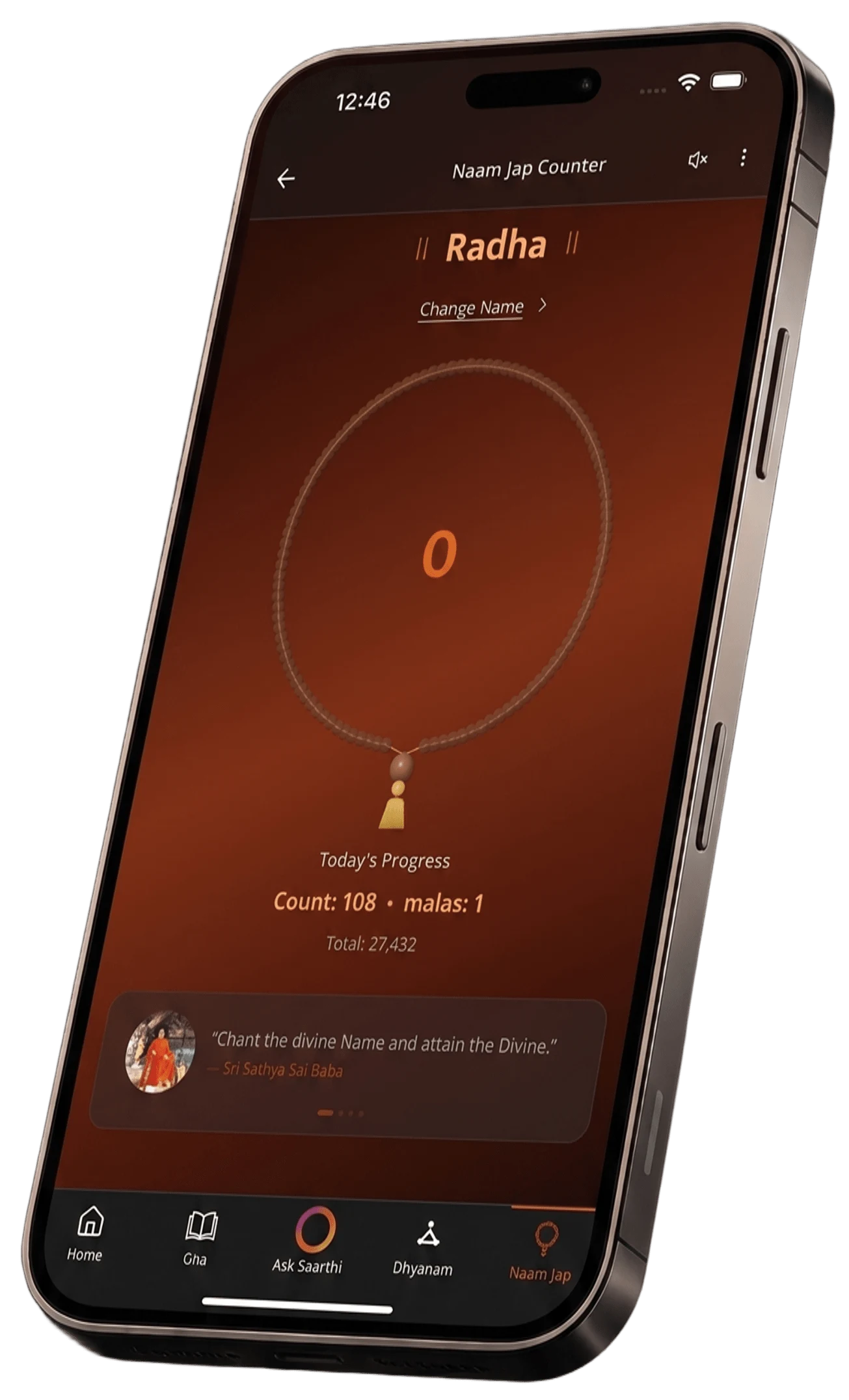
If you want to build a consistent Gayatri practice, Arutra's Naam Jaap feature allows you to track your daily mantra repetitions and build streaks. Many practitioners use it specifically for Gayatri counting — logging their 108 daily repetitions and watching the habit compound over time.
Experience it on Arutra
Download the Arutra App
Guided Naam Jaap sessions, Bhagavad Gita verses, Saarthi AI, and more. Free on Android and iOS.
No download needed