
Millions of people read a daily horoscope, and most assume it is conjured from thin air. In Vedic astrology, a genuine daily reading has a precise mechanism behind it: gochar, or transits. Understanding it will change how you read your horoscope — and what you expect from it.
Two Skies: Your Chart and Today's
Your kundali froze the sky at your birth; that map never changes. But the planets kept moving. At any moment there is a second, live sky overhead. A transit reading compares the two: where is each planet today, relative to where everything stood in your birth chart? When today's Moon crosses the place of your natal Saturn, or Jupiter enters the sign ninth from your Moon, the tradition reads meaning in that contact. The birth chart is the terrain; transits are today's weather moving across it.
Why Your Moon Sign Is the Anchor
Vedic daily horoscopes are counted from the Moon sign, the rashi. Houses for the day are counted with your Moon sign as the first, and each transiting planet's house position from the Moon is read as favourable or challenging. This is why a Vedic daily horoscope asks your rashi, not your birthday month — and why the same day reads differently for different Moon signs.
Fast Planets, Slow Planets
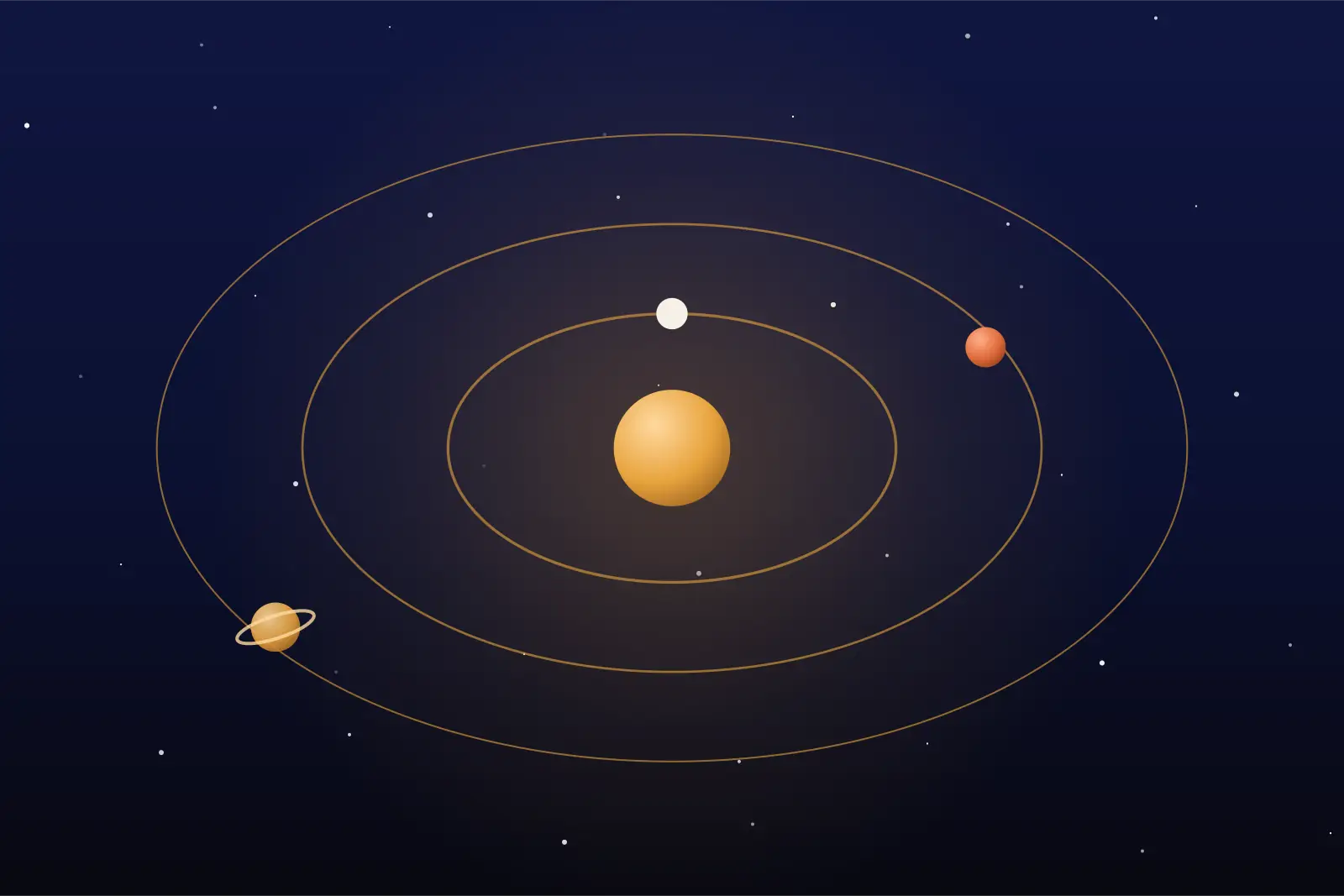
The Moon sweeps through a sign in about two and a quarter days, so it drives the genuinely daily texture: mood, energy, the tone of the next 48 hours. Mercury, Venus, and the Sun shift over weeks, colouring communication, relationships, and visibility. Mars moves in six-week strides. And the slow giants — Jupiter about a year per sign, Saturn about two and a half years, Rahu and Ketu eighteen months — define eras rather than days. A well-made horoscope blends these layers: today's Moon against the backdrop of this year's Jupiter and this era's Saturn.
The Famous Transits
Some transits are household names. Sade Sati is Saturn's roughly seven-and-a-half-year passage across the sign before, on, and after your natal Moon — a period of pressure and restructuring with a fearsome reputation the texts themselves qualify heavily. Jupiter's transit over the Moon or its trines is traditionally a season of growth and support. Rahu and Ketu's transits mark where ambition and detachment pull during their cycle. None of these is a sentence; each is a weather pattern with a known character and a known end date.
What a Good Daily Horoscope Should Do
A fair test of any horoscope: it should be specific to your chart, honest about uncertainty, and useful for the day in front of you. Guidance like watch your words in the first half of the day while the Moon crosses your natal Mercury is astrology doing its job. Vague doom and generic flattery are not.
Arutra Astro builds your daily horoscope from real transits measured against your own Moon sign and nakshatra, and tells you the why in plain words, not just the what. And when a transit raises a bigger question — a Sade Sati worry, a Jupiter opportunity — Jyotish AI can read it against your full chart in chat, any time.
Experience it on Arutra
Download the Arutra App
Guided Astro sessions, Bhagavad Gita verses, Saarthi AI, and more. Free on Android and iOS.

