
Naam Jaap is the practice of repeating a sacred name or mantra with focus and devotion. In Sanskrit, "japa" means to recite, to mutter, or to repeat quietly. For thousands of years, across every school of Hindu philosophy, Naam Jaap has been recognized as one of the most direct paths to spiritual connection — available to anyone, anywhere, at any level of spiritual development.
If you are completely new to this practice, this guide covers everything you need to start today.
Step 1: Choose Your Mantra
The most important thing to know is that there is no single "correct" mantra for everyone. Different traditions within Hinduism emphasize different names and mantras, and all of them carry genuine potency when chanted with sincerity and consistency.
Common starting mantras:
Ram Naam (राम)
The repetition of "Ram" is one of the simplest and most widely practiced forms of Naam Jaap in India. It was Mahatma Gandhi's final word. It is associated with courage, righteousness, and surrender.
Om Namah Shivaya (ॐ नमः शिवाय)
A five-syllable mantra dedicated to Lord Shiva. Meaning roughly "I bow to Shiva" or "I bow to the divine within." Widely used in Shaiva traditions and considered highly purifying.
Hare Krishna (हरे कृष्ण)
The Maha Mantra: "Hare Krishna Hare Krishna Krishna Krishna Hare Hare / Hare Rama Hare Rama Rama Rama Hare Hare." Central to Vaishnavism and ISKCON. Known for its ability to calm the mind quickly.
Gayatri Mantra (गायत्री मंत्र)
A Vedic mantra from the Rigveda, traditionally chanted at sunrise and sunset. Considered among the most sacred mantras in all of Hinduism.
Om Namo Narayanaya
An eight-syllable mantra dedicated to Lord Vishnu. Used across Vaishnava traditions.
If you are unsure which to choose, start with the one that resonates most naturally with you. If you have been raised in a specific tradition (Shaiva, Vaishnava, Shakta), the mantra of that tradition is often the most natural starting point.
Step 2: Decide How Many Repetitions
The traditional unit of Naam Jaap is one mala — 108 repetitions. The number 108 is considered sacred in Hindu tradition for many reasons: there are 108 Upanishads, 108 beads on a mala, and various astronomical and mathematical significances attributed to the number.
For beginners:
Start with one mala (108 repetitions) per day. This takes approximately 5–10 minutes depending on your pace. This is a completely realistic daily target that most people can sustain.
Building up:
As the practice becomes comfortable, many practitioners gradually increase: 3 malas (324 repetitions), 11 malas, 108 malas. Set a goal that feels sustainable before increasing.
If 108 feels like too much at the start:
Even 27 or 54 repetitions daily, done consistently, is more spiritually valuable than 1,008 repetitions done once a month. Consistency is the foundation.
Step 3: Use a Mala (or a Counter)
A mala is a string of 108 beads used to count repetitions. You hold the mala in your right hand, and with each repetition of the mantra, you move one bead with your thumb. When you reach the end of the mala (the "meru" bead, which is the large central bead), you reverse direction rather than crossing over it.
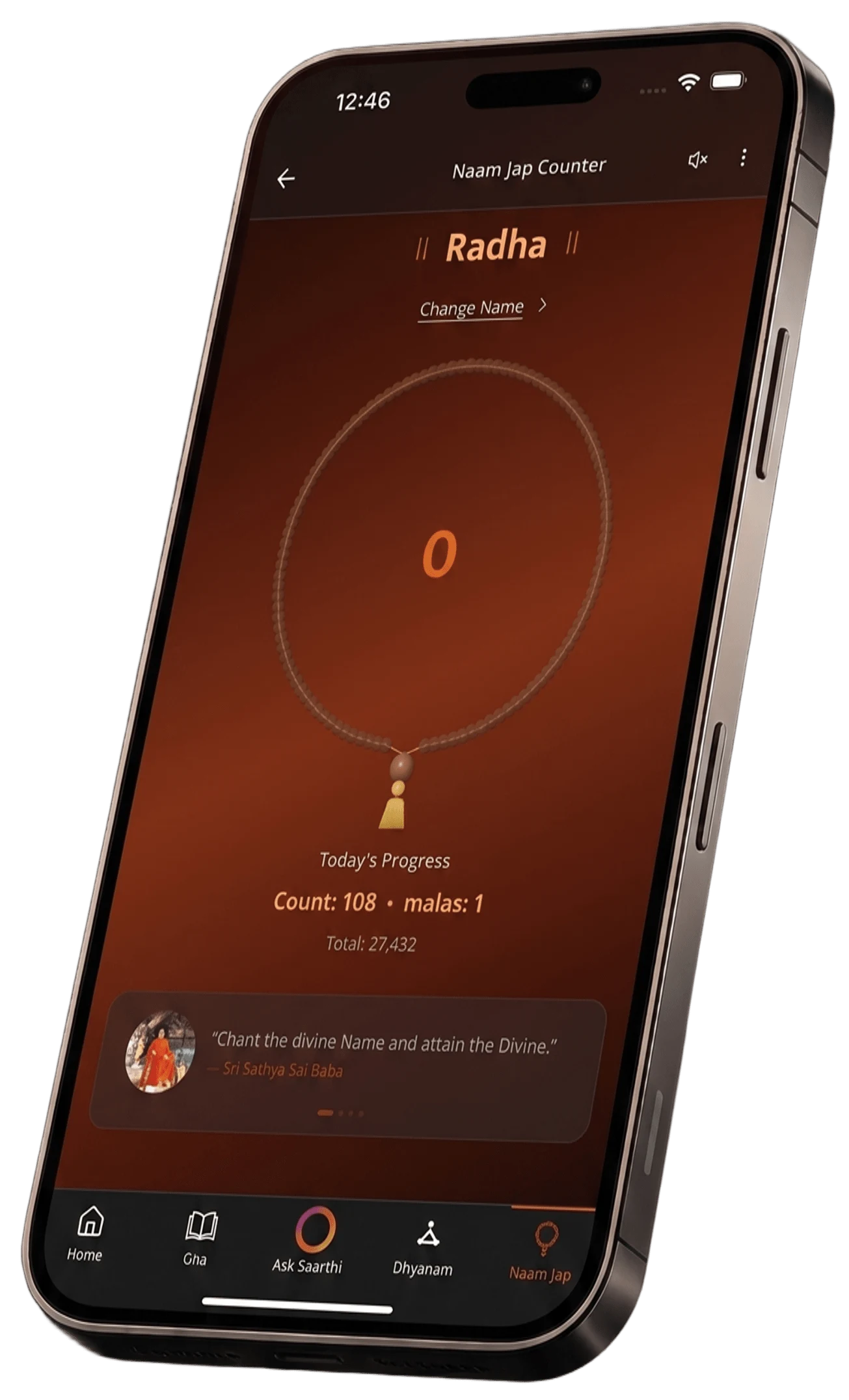
If you do not have a physical mala, you can use Arutra's digital Naam Jaap feature, which provides a tap-to-count system with multiple visual modes — including a Mala mode that simulates the bead-counting experience on your screen. You can also try it directly in your browser at arutra.com/naam-jaap/experience without downloading anything.
Step 4: Find Your Place and Posture
Traditional guidance recommends:
- A clean, quiet space, ideally the same place each day
- Sitting position with the spine relatively upright (cross-legged on the floor, or sitting in a chair)
- Facing East or North when possible
These recommendations are ideal but not mandatory. The most important thing is consistency. Chanting during a walk, a commute, or before sleep is far better than waiting for perfect conditions that never arrive.
Step 5: Begin
Start simply. Settle into your chosen posture, take a few natural breaths, and begin repeating your mantra. The pace should be comfortable — not rushed, not so slow it becomes forced. Each repetition should be clear enough that you can mentally "hear" the name.
Your mind will wander. This is normal and expected. When you notice your mind has drifted, gently return to the mantra without judgment. This returning is itself a form of practice.
Common Questions
Does it need to be spoken aloud?
No. Naam Jaap can be done audibly (vaikhari), in a whisper (upamshu), or purely mentally (manasika). Mental japa is considered the most subtle and powerful, but audible japa is easier for beginners to stay focused with.
Can I do it while walking or doing other things?
Yes. Japa done while walking, cooking, or doing simple tasks is called "ajapa japa" — japa that becomes so internalized it continues without deliberate effort. This is considered an advanced state, but beginning by chanting during walks or simple activities is perfectly fine.
Do I need initiation from a guru first?
For some specific mantras in certain traditions, initiation (diksha) is considered important or necessary. For most common mantras like Ram Naam, Om Namah Shivaya, and Hare Krishna, no formal initiation is required to begin. If you later deepen your practice in a specific tradition, seeking guidance from a teacher is always beneficial.
Track Your Practice
One of the most useful tools for building a consistent Naam Jaap practice is simple tracking. Seeing your daily count and streak builds the habit loop that makes consistency easier over time.
Arutra's Naam Jaap feature lets you log your daily repetitions, track streaks, and set personal goals. The global community counter also shows you that millions of repetitions are being completed daily by seekers around the world — a quiet reminder that you are not practicing alone.
Start with one mala. Come back tomorrow. The practice builds itself.
Experience it on Arutra
Download the Arutra App
Guided Naam Jaap sessions, Bhagavad Gita verses, Saarthi AI, and more. Free on Android and iOS.
No download needed