
Pick up any japa mala and count the beads: you will find 108, plus one larger bead called the sumeru or guru bead. This is not arbitrary. The number 108 is woven into the fabric of Hindu cosmology, astronomy, and physiology in ways that are genuinely remarkable.
The Astronomy Behind 108
The average distance from Earth to the Sun is approximately 108 times the Sun's diameter. The average distance from Earth to the Moon is approximately 108 times the Moon's diameter. Ancient Vedic astronomers, working without telescopes, arrived at these ratios through meticulous observation and recorded them in texts like the Surya Siddhanta. Whether one reads this as cosmic coincidence or as evidence of a deeper order in creation, the number clearly held significance for those who framed spiritual practice within a cosmological worldview.
108 in the Yogic Body
In yogic anatomy, the body is said to contain 108 nadis, or subtle energy channels, converging at the heart center, the Anahata chakra. By completing 108 repetitions of a mantra, the practitioner is symbolically activating and purifying each of these channels. The Sanskrit alphabet consists of 54 letters, each with a masculine (Shiva) and feminine (Shakti) aspect, giving 108 total expressions of sound. The number also appears in the Upanishads: there are 108 Upanishadic texts.
A Self-Contained Unit of Practice
From a practical standpoint, completing one full mala of 108 repetitions takes roughly five to fifteen minutes depending on the mantra and pace. This makes it a naturally self-contained unit of practice. Many practitioners aim for one mala per sitting, while serious sadhaks may do three, five, or even eleven malas in a session.
The Guru Bead and Its Meaning
The guru bead at the summit of the mala serves as a pivot point. When your fingers reach it, you do not cross it. Instead, you turn the mala around and begin again in the reverse direction. This gesture of reversal carries meaning: the guru bead represents the teacher or the divine, and crossing it would symbolize going beyond the source. The instruction to turn back is, in a quiet way, an instruction to remain oriented toward the source rather than wandering past it.
Different Counts and Their Validity
Different traditions recommend different counts. Some teachers prescribe 27 repetitions (one quarter of a mala), others 54 (half a mala), and 108 for a full mala. Each is considered valid, and the tradition gives practitioners flexibility based on their time and capacity. What matters most is that the practice is regular and done with genuine attention.
Why Counting Beads Helps
Counting beads also serves a practical function: it frees the mind from having to track numbers, leaving it available to rest in the meaning and sound of the mantra itself. The physical sensation of moving from bead to bead provides a gentle kinesthetic anchor that supports sustained concentration.
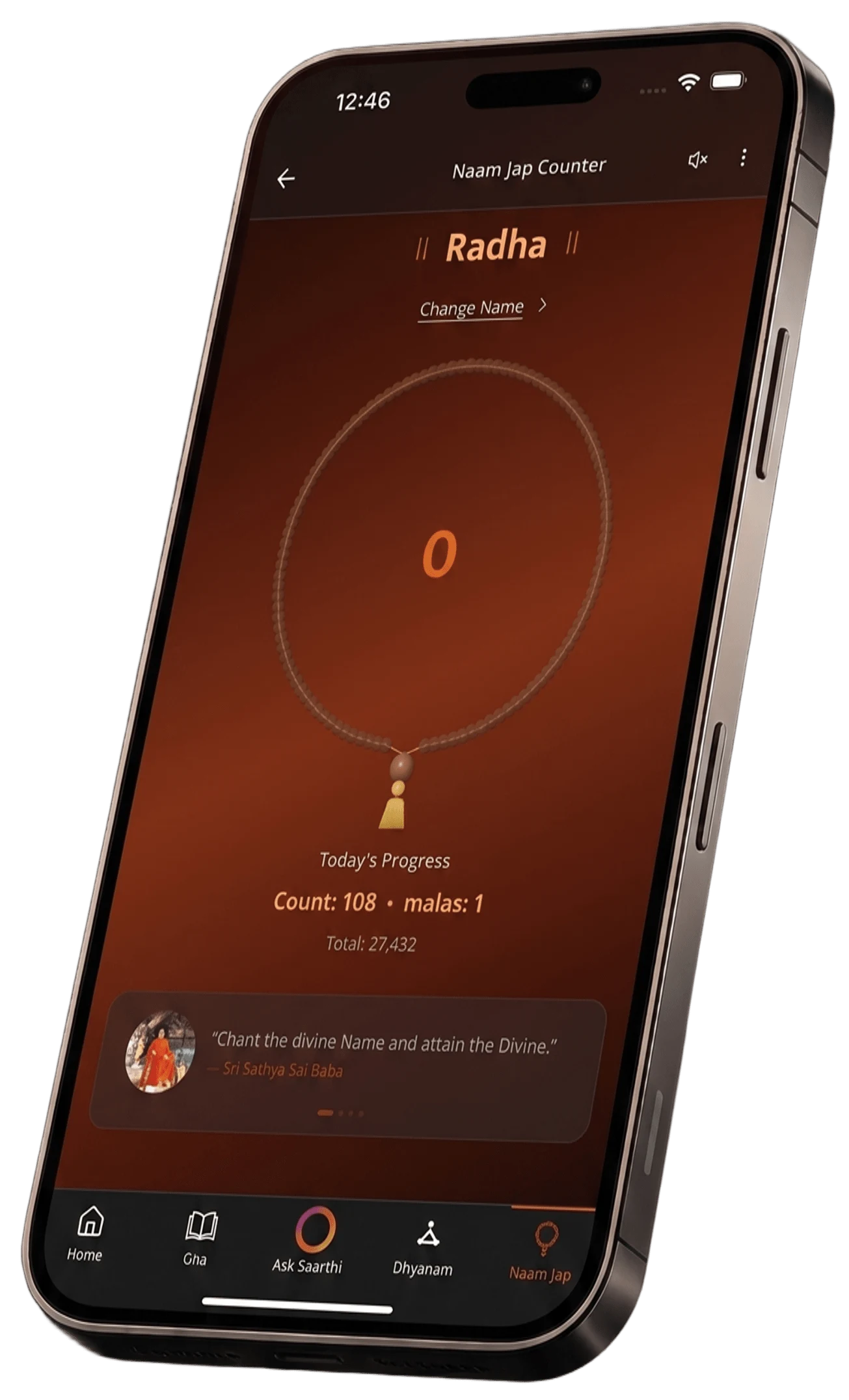
The Arutra app includes a built-in mala counter that tracks your japa sessions digitally, so you can focus fully on the practice without worrying about losing count.
Experience it on Arutra
Download the Arutra App
Guided Naam Jaap sessions, Bhagavad Gita verses, Saarthi AI, and more. Free on Android and iOS.
No download needed