
The Sanskrit word praarthana comes from the root arth, which means to long for, to ask sincerely. Unlike a rote recitation or a mechanical ritual, praarthana is understood as an act of genuine communication, a turning of the heart toward something larger than oneself. This is what distinguishes it from mere religious performance.
Prayer as Relationship
In the Hindu understanding, prayer is not primarily a transaction where you give something to the divine in exchange for a favor. At its deepest level, praarthana is an act of relationship. The devotee is reaching toward the Ishvara, the personal divine, with the same combination of love, need, gratitude, and trust that a child might bring to a parent who is both beyond reach and entirely present.
Modes of Prayer
The tradition recognizes several modes of prayer. There is Stuti, or praise, where you acknowledge and celebrate the qualities of the divine. There is Prarthana in the narrower sense, which is petition. There is Vandana, prostration and homage, where the gesture of the body expresses the humility of the heart. There is Upasana, meditative dwelling in the presence of the divine. Each is valid, and in practice they often flow into one another during a single sitting.
Setting Up a Simple Practice
For a beginner setting up a home practice, the question is often where to start. You do not need an elaborate altar or a set of rules about correct procedure. A clean, dedicated space with a simple image or murti, a small lamp (diya) and perhaps some incense or flowers, is more than sufficient. What matters is that the space is treated with some care and that you return to it regularly.
Beginning with Presence
Begin with a pause. Before launching into a recitation or a list of requests, sit quietly for a moment and become aware of where you are, what you are bringing to this moment, and what you are genuinely reaching toward. This brief settling is itself a form of prayer.
Choosing Words That Are Yours
Then, if you know a simple shloka or prayer, offer it with attention. The Gayatri Mantra, the Mahamrityunjaya Mantra, or something as simple as "Om Namah Shivaya" are all valid starting points. If you do not know any Sanskrit, speaking in your own language, directly and honestly, is equally valid. Many of the great bhakti saints wrote in vernacular languages precisely because the heart's language does not require Sanskrit to reach the divine.
The Role of Gratitude
Gratitude is an underemphasized dimension of prayer. Before asking for anything, pausing to acknowledge what is already present in your life tends to shift the quality of the prayer toward something more spacious and less contracted.
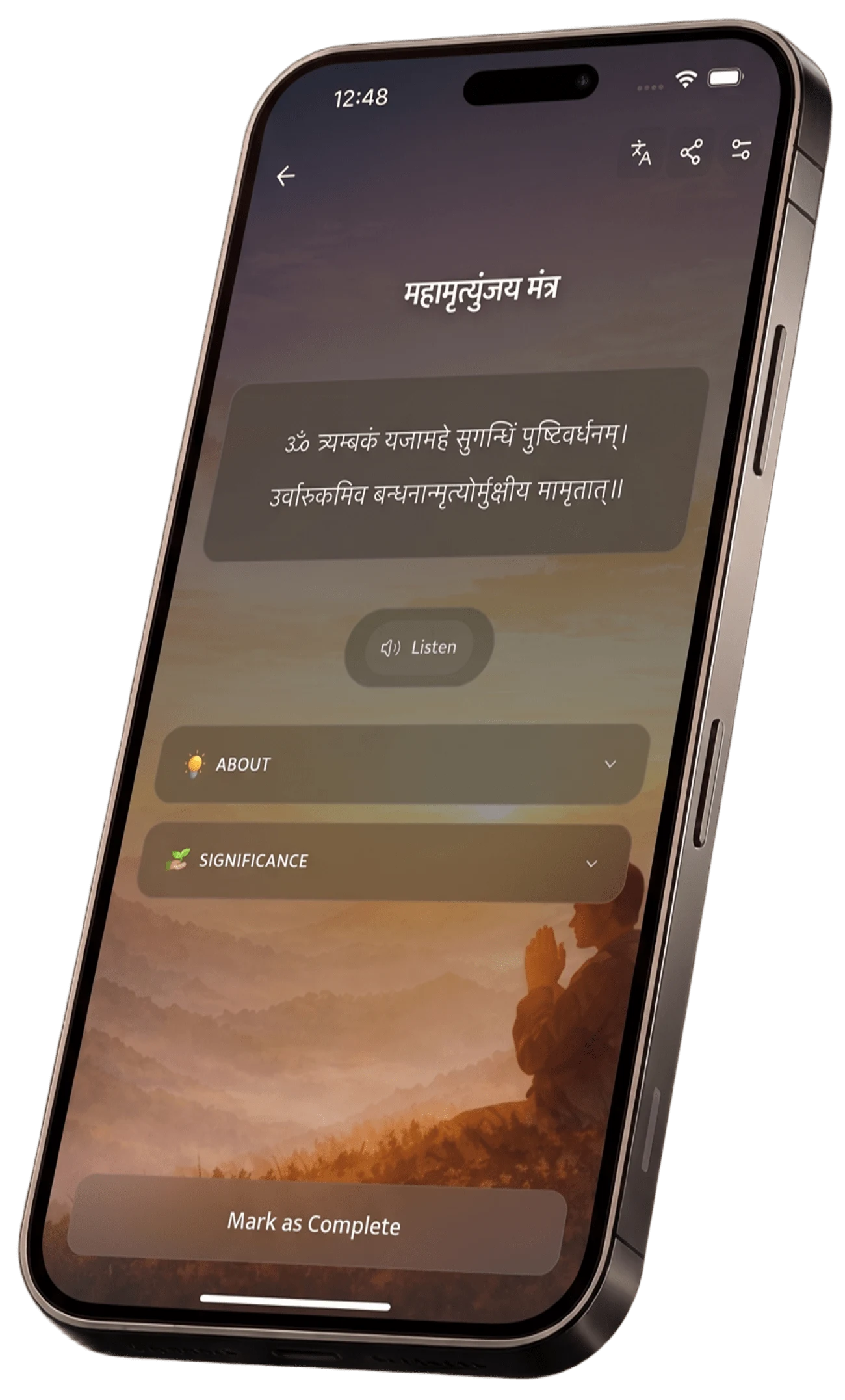
For those who want guidance in structuring a daily Praarthana practice, the Arutra app offers a curated collection of prayers, morning and evening routines, and devotional audio to support your home worship.
Experience it on Arutra
Download the Arutra App
Guided Praarthana sessions, Bhagavad Gita verses, Saarthi AI, and more. Free on Android and iOS.